Una Lettera da Firenze
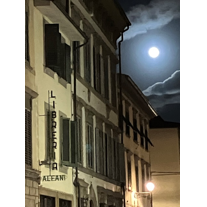
Alora, another week has passed. Remarkably, it started just like yours, though perhaps your view of the harvest moon was not as clear as ours.
After our first week, we have made more time to take in some of the sights. Our first stop was San Marco, a museum that used to be a monastery, built by Cosimo de’ Medici to help ease his way into heaven. Two notable residents (other than Cosimo, who did indeed have his own cell for the times when the world got too loud) left their particular traces behind.
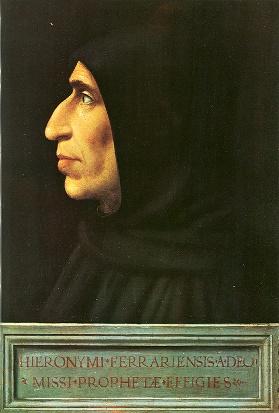
The first was Girolamo Savonarola, a monk who, in 1494, rose from obscurity to lead the City of Florence while Piero de’ Medici fled out the back gate, pursued by French troops. The charismatic Savonarola encouraged people to think that God was their only ruler. It is him we have to thank for “bonfires of the vanities”. But, despite purging their households of books and art, things did not go well for the Florentines or for him. In 1498, after admitting he made it all up, he was publicly flayed, eviscerated and, once dead, tied to a stake and burned. However, he had the last laugh. As the pyre grew, his right arm magically, suddenly, shot up in the air, his index finger pointing to the sky. And it stayed there. The thousands of onlookers, crammed into the Piazza della Signoria for the show, panicked and fled. Scores of people were trampled to death. His cells at San Marco are kept as a shrine. This quite astonishing portrait of him hangs there, painted in 1497. Many still think quite highly of him.
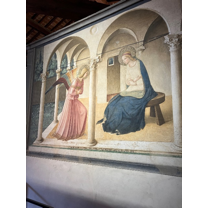
The other, rather quieter, resident was Beato Angelico better know to the rest of us as Fra Angelico (1395-1455). San Marco is, essentially, a museum devoted to his work. But unlike other museums that honor one individual artist, most of the paintings and frescoes here were created in situ, including this one, which many of you have seen in art history class.
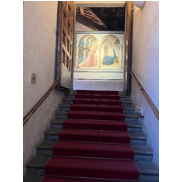
There are two things in this painting of the Archangel Gabriel’s encounter with Mother Mary (circa 1440) that they don’t tell you in that class. The first is that this astonishing fresco is aligned such that it fills your field of vision as you climb the stairs. And the only people who climbed them were the monks. Their cells—each one containing one of Fra Angelico frescoes– were on this upper level. Thousands upon millions of words have been written about this painting so I won’t go into what makes it so magical. I will say that both Susan and I fell in love with it. But I do have to tell you about the other thing they don’t tell you in art history class. This alone is why you must come to Florence if you’ve never been; and if you did not notice it, why you must come back. Do not die before seeing this detail, you will regret it.
Gabriel. A name I quite like. This is a city of Gabriels, a city with Annunciations in every tourist-crap shop, a city where under-employed archangels sell Gelato, and in this city there is no more empathetic, sublime Gabriel than Fra Angelico’s.
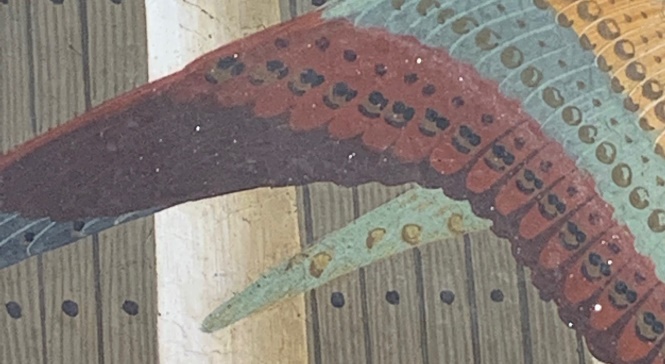
Admiring it, I say to Susan, “Oh my god, look at his wings!” Folks, they sparkle. Fra Angelico actually added a silica of some kind to the fresco (which is made with wet plaster and pigment). And the wings, only the wings, sparkle. They still sparkle and glint after almost 600 years! You can barely tell from this photo (the little white bits). That is why you have to come here.
There is indeed lots of nice old art here. But we were treated to the work of two obscure twentieth-century artists whose work we were amazed by. The first was from an exhibition tucked into the Palazzo Medici-Riccardi of the work of Oscar Ghiglia (1876-1945). Look it up in Google Images to see much more of the show. It is the first exhibition of this artist’s work, 80 to 90 years after it was done. He is basically totally unknown to the greater world. It was an extraordinary exhibit.
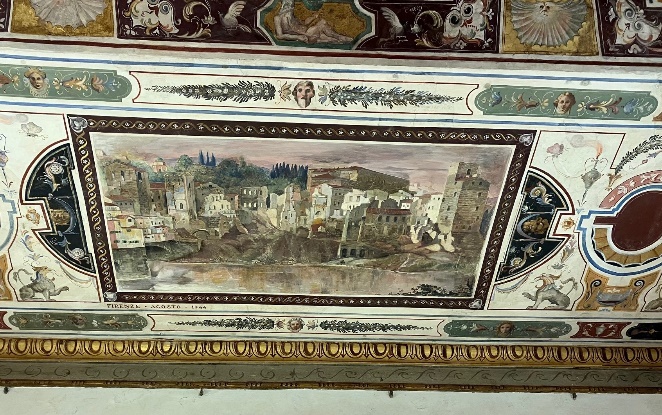
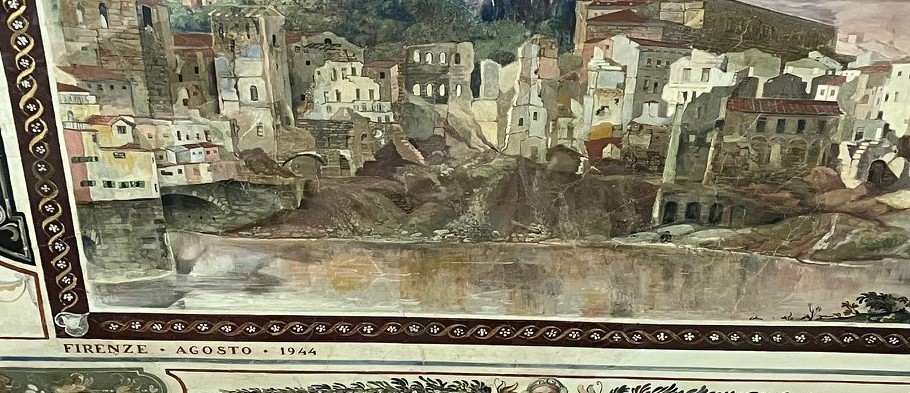
Now, we don’t know the name or the date of the next twentieth-century work we encountered, merely that it is post World War II. What we do know is that we found it while we were experiencing the local mosh-pit. The Italian word for mosh-pit, if you want to know, is Uffizi. No, I never knew that either. Anyway, there we were making our way through the room of Quattrocento Lombardy paintings. It was a small room and we were there with 450 close friends. Susan was looking up at the marvelous decorative ceilings, perhaps hoping for fresher air. Says she to me, “Oh my god, look up!” The ceiling of this room, as most the others, was painted sometime during the sixteenth century. It is full of scenes of historic battles; images of Mars, god of war; and lots of armed folks lunging at each other. But then there was this one. Notice the date on the close-up below:
Firenze, Agosto, 1944. I recognized this view from photographs of Florence taken the summer the Nazis retreated, demolishing four of the five main ancient stone bridges as they left. What was so astonishing is that it was on this ceiling. There were, as far as we could see in the whole museum, no other contemporary representations of anything. There was no wall sign, no indication of who, when, why or how this piece came to be there. And no one else was looking up.
I have made inquiries with the woman at my school with whom I am taking the Florence Culture class. She was not aware of it but is checking with her people and may have an answer next week. Which I will pass on in the next installment. Stay tuned.
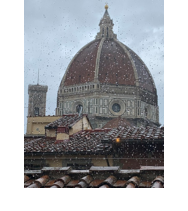
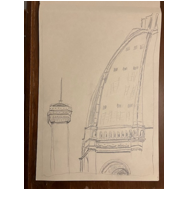
Ok, this is getting long. Just to say today we joined the Florence Urban Sketchers group (there is one in every city in the world, just about) and found a lovely group of people. They led us to a most astonishing perch from which to observe the Duomo. The roof terrace of the Biblioteca delle Oblate. It is just the local public library (another converted monestary). It’s huge, with a marvelous café on the top floor & not a tourist in sight. Here you see Susan’s version of the amazing view. The terrace is covered which was a good thing because it was raining very hard.
Put the Biblioteca on your list.
Oh, one more thing. I went into the fourth floor museum space at the Spedale degli Innocenti where no one ever goes. There, in Brunelleschi’s 1435 foundling hospital, I found a most exquisite Sandro Botticelli painting. Just waiting for me.
As Florence waits for you…