Reflections.
A review of the parts of the brain:
The Frontal Lobe
The Occipital Lobe
The Cerebellum
The Parietal Lobe
The Temporal Lobe
The Venetian Lobe
This last part of the brain, tucked below the pre-frontal cortex, is where we store memories of Venice. If one has not been, the lobe is there, it is just waiting for the vacancy sign to be removed.
We have just come back from four days and nights there, our first together. None of my words or images would be adequate to convey the experience. You have had your own or you haven’t. Those images and memories are stored in your Venetian Lobe because Venice is like no place on earth. It is nothing like Florence, or any other Italian city. I have been sharing Florence with you but Florence, while amazing, is not that different from where you live. It has streets, cars, trucks, bicycles. If you live in a city, then like yours Florence has demented scooter drivers, motor cycles, stop lights, and traffic noise. If you live in the country, you have nature sounds during the day and night. But wherever you live you don’t cross a bridge to get from one side of the street to the other. Where you live your new couch isn’t delivered by boat. Where you live isn’t devoid of sound at night. So silent your ears strain in wonder. Venice is just Venice.
Well, maybe I will share this: when I teach my design history sections on Shaker design, I bring the students this dictum from The United Society of the Believers in Christ’s Second Coming, as the Shakers referred to themselves. A dictum that sums up Venice:
Do not make something unless it is both necessary and useful; but if it is both necessary and useful, do not hesitate to make it beautiful.
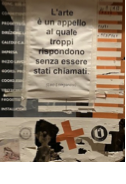
Ok, one picture. Something I doubt you saw when you were there. Late one night (the very best time to be walking around Venice), close to the Peggy Guggenheim Museum, we found this sentiment taped to a door: “L’arte é un appello al quale troppi rispondono senza essere stati chiamati”. I walked right past it but the Italian speaking half of this relationship pulled to a halt. Perhaps this is an expression you know. It was new to us. “Art is a calling to which many respond without having been called.”
That is it. No more Venice pictures.
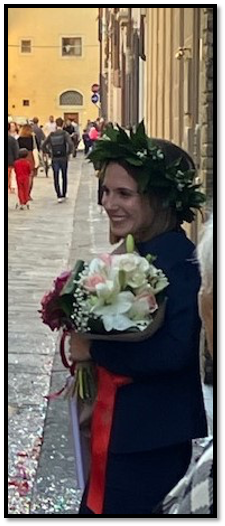
In the interests of continuity, I will note that my mention of the bay laurel wreath on the Donatello David’s head in Lettera Sei elicited some replies. One of my correspondents mentioned that graduate students in parts of Italy were likewise lauded. And, lo and behold, Susan and I encountered this woman, surrounded by family and friends, confetti and flowers, with her bay-laurel laureate’s wreath. She is standing on the steps of one of the universities here. You can see confetti all over the sidewalk and street. She was radiant and it all seemed quite joyous. I took this picture from the hip so as to not intrude. Anyway, I just thought you might enjoy seeing this.
I will also add one more reply from a reader friend regarding Lettera Sette’s Under the Tuscan Buns, noting that her husband was elected as having the “Best bum in the boathouse” at Penn. Thank you all for your input. I enjoy hearing your stories and the memories these letters prompt.
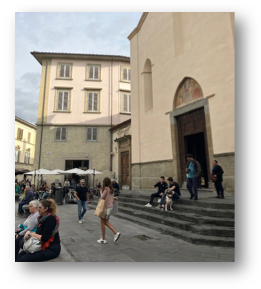
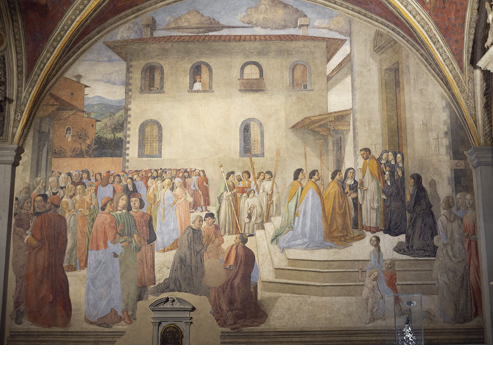
So, last Saturday we went east of us to the Sant’Ambrogio area for the first time. This is where one finds the other, more intimate, mercato in Florence; also, the nineteenth-century synagogue; the modest Chiesa Sant’Ambrogio and in front of it the Piazza Sant’Ambrogio where I enjoyed the best coffee so far. But this is by a very small degree as the coffee everywhere in this land is ambrosia. It turns out to be a delightful neighborhood with very few tourists. Follow along as I would like to show you a fresco from the church that I found fascinating.
It is rare to come upon frescos that represent real scenes, so this is particularly special. Painted in 1486 to honor a nifty miracle that occurred inside Sant’Ambrogio, you get to see a whole streetscape. Look closely at the two images. Not much has changed except the women’s dresses are shorter and the men’s dresses seem to have rather disappeared. The windows are no longer arched in the building behind but it is likely the same building. Pretty cool, eh? I mean the frescoist – Cosimo Rosseli – had to have stood on this spot to do his preliminary sketches. 536 years ago. Well 538. It took him two years to create this busy scene (the painter’s self-portrait is looking out at you from the lower left corner, by the way).
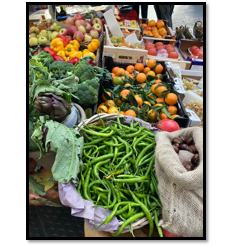
This photograph is from the Sant’Ambrosio market. Maybe more than anything else, after nine weeks in Florence, I am still stunned by the freshness of the produce here, by its abundance, by the care its purveyors lavish on it. I mean, look at this display. This beauty is not accidental.
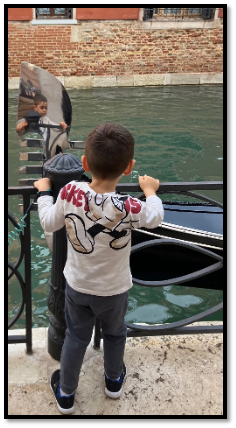
OK, one more Venice photo of a little boy checking out his reflection in the prow of a gondola.
Arrivederci,
Warren
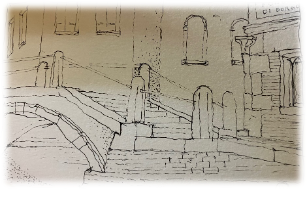
We did have some fine opportunities to just sit and draw in Venice.