I am writing this with earplugs in my ears. Those nice cylindrical foam ones. Very effective. Not far outside our window, on most days, there is a rather ancient accordion player busking. He is quite capable. I have no doubt that in his youth he played for dance bands and rollicking parties. But that was a long time ago. He is something of a fixture on Via Ricasole. And for the last fifteen minutes he has been playing the tune from “Aye, yi, yi yi, I am the Frito Bandito”. Now, I am sure this Frito’s Corn Chips jingle has a proper source but really, whatever, it is a very annoying song. Thus, earplugs. When we pass by this accordionist, we usually drop some change in his hat. Sometimes the money is to encourage him, other times it is so he makes enough money that day to please, please stop.
But for me, he always redeems himself when he plays the theme from Never on Sunday, which is a movie we watched recently here, courtesy of Amazon.it. With Melina Mercouri and written, directed by, and starring Jules Dassin. It was released in 1960 and, through the miracle of the internet, I see that Manos Hadjidakis won an Academy Award for its evocative score. Have you seen the movie lately? It is absolutely unlike anything ever made in Hollywood. It is superb. Do you remember the tune? I am sorry, I didn’t hear you. Oh – wait, my ear plugs – there, that’s better. I will sing it for you. Dah dah dah dah. Dada da da dah. Dada da da dah. Dada da da dah. It’s coming back to you now? Good. Go watch it. Then put on the record.
I so clearly remember that this movie came out shortly after we moved to Larchmont, New York, from sunny, lovely Los Altos, California where we had a grove of orange, lemon and grapefruit trees in the front yard and a lanai in the back. We drove the whole way and arrived in Larchmont at the end of August, 1960. I was not happy about this move. My sisters weren’t too thrilled either. I have polled them this week. Margaret notes that she was bummed to abandon her best friend, known fondly as “little monkey”. Polly remembers arriving smack in the middle of Hurricane Donna which trounced lower New York. I remember that the first thing Lou Ashworth bought were yellow rain slickers for all of us. I was five in 1960 but by then my sisters were already way old and I remember being distinctly irritated when they got to go to the Larchmont Playhouse and see Never on Sunday and I was not allowed to go. So what if I didn’t know what a prostitute was? I could learn, couldn’t I?
There are some other movies we have seen here that are just marvelous: Marriage, Italian Style. Marcello Mastroianni and Sophia Loren. Another movie would never have been conceived in America. A revelation, such an interesting plot and such mesmerizing acting. I had heard of the 1961 Divorce, Italian Style but did not know of this 1964 companion piece. Sophia Loren is at her best and often, brilliantly, looking her worst. We also watched Zorba, the Greek, made the same year. It holds up very well. And it is so oddly close to the book I am reading now by Carlo Levi called Christ Stopped at Eboli (1945) about Levi’s years in exile in southern Italy as an enemy of Mussolini’s state. Both works describe a world so primitive it is very hard to fathom.
Susan and I have been attending weekly life-drawing sessions since we have been here. Afterwards, there is always wine served and one is encouraged to linger and visit and it is a great way to meet people. But it did not occur to me, until I encountered the story of this crucifix, that life drawing is something of a privilege. The fact is, artists such as Michelangelo, Leonardo, Donatello or any of the other mutant ninja turtles, were not at liberty to work from nude models, particularly female models. It was not done. If they wanted to study the human form, they usually had to draw from cadavers and those were very hard to come by. This became apparent to me (it is well-known to real art historians) when I read about this crucifix. It was carved out of lime wood by Michelangelo, at the age of eighteen, as a gift to the prior of Santo Spirito monastery in thanks for being allowed access to fresh, dead bodies from their small hospital. It hangs in the Santo Spirito sacristy today.
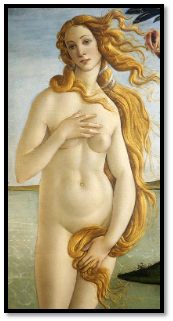
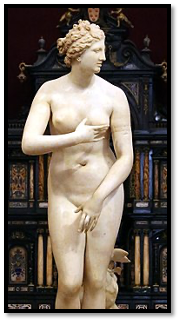
Botticelli had the same constraints. His famous Birth of Venus, here in the Uffizi, was not painted from life but modeled directly from a Roman sculpture to which he appended the head of his muse, Simonetta Vespucci (yes, cousin by marriage of Amerigo for whom America is named, who lived around the corner from us when he wasn’t at sea).[1] This first century BCE sculpture of Venus, left, had been acquired by the Medicis and all the artists mentioned here came to their palazzo courtyard to draw her. No doubt, when their cadavers were getting a bit ripe, they appreciated some outdoor sketching time with stone-cold nudes. It is interesting to me that the creators of so many extraordinary works were bound by this constraint.
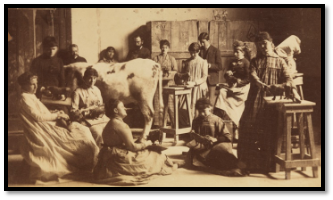
But don’t scoff too quickly, thinking how advanced our civilization is. It might interest you to know that it was not until the late 1880s that the first female art students were allowed to draw from the human figure in American academies. Below is an image of the Pennsylvania Academy of the Fine Arts’ “life modeling” class in Philadelphia in 1882. The women are all students of Thomas Eakins (at the rear), whose work I loathe. They are drawing and sculpting from a cow brought in for the session. The person who broke this pattern, by the way, was a teacher at that Academy named Alice Barber Stephens. It would be another generation until many of the European academies allowed their women to be exposed to the pernicious naked human figure.
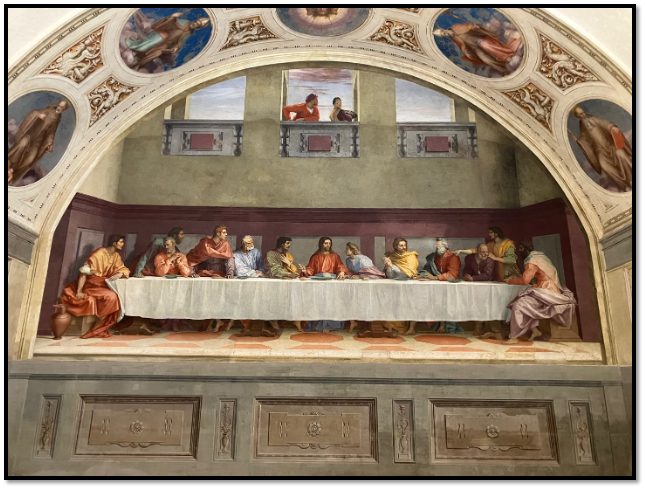
Regarding arty matters, back in Lettera Cinque I mentioned the cenaculo – l’ultima cena, or last supper – fresco, at San Salvi. This former monastery is on the edge of greater Florence, a ten-minute bus ride from our apartment. Susan needed a break from work so we decided to head out there as she had not seen it before. San Salvi had been a monastery and has been converted into a small museum where Andrea del Sarto’s Last Supper is in the former refectory right where it was installed, 500 years ago. It is in excellent condition and looks as if it might have been finished last week. Just as the first time I visited, this small museum was empty except for the nice woman who looks after it. There are a number of other works by people of del Sarto’s circle. Though small and out of the way, this museum is just beautifully lit, clean, clearly and thoughtfully curated in Italian and English, very welcoming, and free. It is typical of a new wave of art and architecture stewardship that is a major testament to the City of Florence. There are signs everywhere that tourist dollars here are being spent on active conservation and broadly revitalized and sensitive exhibitions.
Andrea del Sarto, 1505, Cenaculo in the refectory of San Salvi Monastery in Florence.
After we left the apostles, whose meal – from all the evidence I have seen – was meager, we lucked into perhaps the best Italian restaurant food we have had since coming here (excepting Venice, dove tutti i pranzi e le cene sono sublime). It was just in a little osteria a block from San Salvi, catering to locals. Among all the other delights, their semi-freddo dessert (served with complimentary, homemade limoncello) was supremely delicious. Even the waiter was supremely delicious and we wished we could bring him home.
Leaving aside l’ultima cena, I don’t want this letter to go out without acknowledging l’ultima stagione of Cantata Profana. I suppose almost all of the correspondents who receive this letter are also fans of Cantata Profana, thus you know by now that they have announced that this is their last season and, in fact, November 4 is the season’s first concert. Could it be that the Barbara Strozzi mentioned in the advance program notes is related to the Florentine Strozzi family who built the largest palazzo in central Florence?
Cantata Profana has simply spoiled us all. For myself, when we go to other concerts now, I wonder who was asleep at the wheel coming up with its dull programming, and really, couldn’t they be just a little imaginative with the lighting? Have they any inkling that a published program could be made witty and interesting? We were at just such a concert last week and I was wondering, did it never occur to them that music does not have to be presented in chronological order? Did they not know that there was music before Bach? After Brahms? Well, poor ignoramuses, they never saw a CP show. And we are quite sorry to miss the show tonight though we are enjoying the advance program notes. Do we miss anything else about New York, you ask? Don’t.
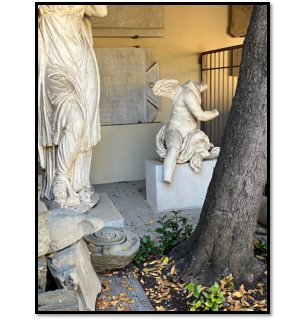
I will end with this delightful image. The other day we were out visiting the church at Santa Croce and wandered around the very gracious back of it where, next to the janitor’s parking spot, we came upon their spare-angel storage area. So useful. You just never know when you might need one.
Arrivederci,
Warren Ashworth
[1] To be clear, there is much debate about this. Simonetta died at age 24, ten years before this painting was done.