The moon is full again. That means there will only be two more of these letters. When the old moon is in the new moon’s arms, we fly over it to return to New York. Meanwhile there is, in the Uffizi, an amazing annunciation I must bring to your attention.
Setting aside the fact that this, and almost every annunciation after 1100 CE, shows Mary reading, though no such thing is mentioned in the New Testament;
Setting aside the fact that her reading material is a book even though in the year 1 scrolls were what were read, books with bindings not appearing until seven centuries later;
Setting aside the fact that a woman who has been taught to read in either the first century CE or the fifteenth century was a very rare thing;
Setting aside the fact that she is shown with a medieval setting behind her of a style of buildings that did not exist in the first century;
Setting aside the fact that in this and almost every other annunciation except Fra Angelico’s (see Lettera Due,) the Virgin Mary is shown in garments and in a building indicating a very affluent, well-born life of leisure, even though the New Testament indicates she is of a “humble state” (Luke 1:46-55);
Setting aside that, via the agency of an angel, a virgin is being impregnated by a dove (Luke 1:1-4) and that she is unmarried when she becomes pregnant, and that she only gets married later to a nice old guy for convenience and that the painter is participating in perhaps the biggest con of the eon;
Setting all that aside, it is a really dynamic and beautiful painting. It is known as the Cestello Annunciation by Sandro Botticelli. In every other annunciation we have seen (probably 70 or 80 by now,) Mary receives the big news in a passive pose. Here, she limbos to her left, “her body in thrall to the divine message that has been transmitted from Gabriel’s fingertips to her own”. That quote is from author Joseph Luzzi’s new book Botticelli’s Secret: The Lost Drawings and the Rediscovery of the Renaissance. Her “earthy and earthly” sway here is unique, it is vibrant. Luzzi goes on to say “The angel has come to proclaim the coming of God. Botticelli has come to proclaim a different arrival. If ever a historical epoch could be conveyed in a single, simple gesture, here it was: Botticelli’s annunciation of the Renaissance.” Nifty, eh?
Just one detail before we leave Gabriel and Mary. Unlike so many of the works I have mentioned in these letters, this large painting is not a fresco. It is egg tempera on wood, a medium Botticelli really knew his way around. Back in your college days, when your domestic hygiene standards were lower and you had some big paper due, that plate from the fried eggs you left in the sink for three days was really hard to clean, right?. Well, that is the magic of egg tempera. Yolks mixed with pigment and ancillary ingredients make a workable painting medium that is color-fast for centuries (unlike oil paint, which fades and yellows over time). It bonds to a prepared ground and does not want to let go, like your eggs. But it is a very difficult medium to work with. Few painters use it nowadays.[1] One major exception being Andrew Wyeth. Botticelli’s enormous Birth of Venus and his Primavera, across the room from the Cestello Annunciation, were painted in egg tempera.
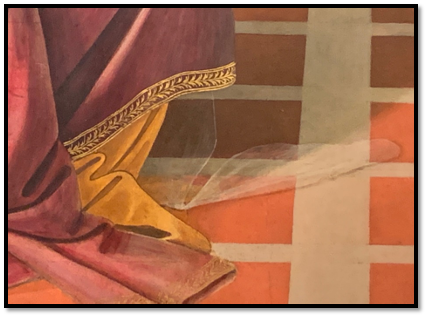
Where I am going with this is to ask you to please just look at that fold of gossamer fabric on the floor in front of Gabriel. Is that not breathtaking? That is Botticelli is saying we know how to do this now and the world will never be the same.
Who doesn’t love Artemesia Gentileschi (1593-1656)? A big-boned gal with lots of mettle. Seventeenth-century heroine, brilliant painter, fighter for justice, rare female inheritor of her father’s trade, exile, teller of truths, and unlike many men, not scared of a little blood. She arrived here in Florence at the age of 23 right after the man who raped her in Rome was convicted of all charges (though he never served his punishment). She was welcomed by Cosimo Medici II, who was continuing the patronage of the arts started by his forebears. He introduced her to all the right people in town including Michelangelo Buonarotti the Younger, nephew of the master. Her time here was immensely fruitful. For his own home, Buonarotti engaged for her to paint an “allegory of inclination”. The fee was the handsome sum of thirty-four florins, the commission, a ceiling panel. It was to be installed in a special room he’d designed to honor his uncle, from whom he had inherited the house. Hers joined the work of other contemporary painters to honor that great, grumpy, jealous, paranoid, impatient man.
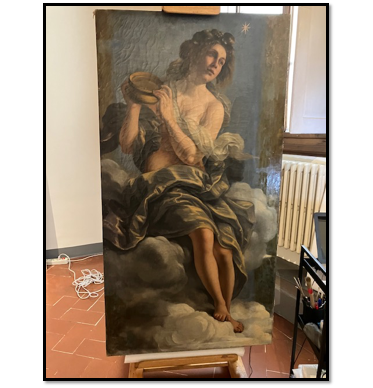
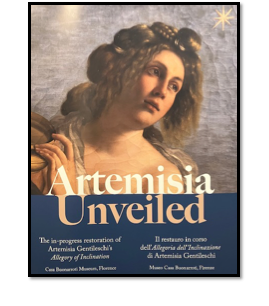
I could not imagine what an allegory of inclination might look like, so Susan and I jumped at the opportunity to view this one up close at the Casa Buonarotti where it has just been taken down off the ceiling. It suffered terribly with age and gravity and was in serious need of rescue. It was painted not with egg tempera but with oil paint, as was common by her time (oil painting was invented in the low countries in the late 1400s and came south to Italy around the middle of the 1500s). In this case, the paint did not bond at all well to the ground and the ceiling panel has been a peeling wreck for years. The exciting thing is that it is being rescued and the rescue is being done in situ at the Casa Buonarotti by renowned restorer Elizabeth Wicks. So, here is our allegorical figure, inclining, and in the process of being reinvigorated.
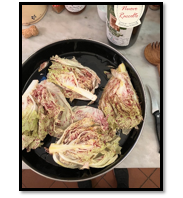
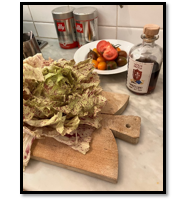
Over and over, I find preparing food here is like I am interrupting someone’s still life. Sometimes, I don’t want to cut up the vegetables because they are so gorgeous. Look at this thing my ortolana offered me. She told me its name but I did not catch it. Was it like lettuce, I asked, in some version of Italian. No, she said, it is more like scarola (escarole) and you have to cook it briefly. Well, I knew how to do that. Anyway, I went ahead and cut it up and it was still beautiful. We had it last night as part of a lovely dinner for eight with the Wilson clan. By the way, that is our bottle of Florentine Amaro there on the counter, next to more tomatoes which are still, saints be praised, in season.[2]
Regarding the indefatigable accordion player mentioned in Lettera Nove, I wanted to say that our friend Tony Piccolo has replied that he is pretty sure Cielito Lindo (Pretty Sky) is the name of the original song our accordionist plays with such regularity. This is cold comfort since I still, regularly, find myself in the kitchen, singing “Ay yi, yi yi”. Oy.
I have just made myself an Amaro Spritz with the above-mentioned native elixir. Herewith the recipe: 2 oz. Amaro; 3 oz. champagne or prosecco; 1 oz. seltzer; 1 orange peel.
So, my nephew Peter Wilson, his wife Jill and their two excellent daughters, Isaura and Dahlia, aged 13 and 1l, are here visiting. We last saw them at Jacob and Peregrine’s wedding where we told them about our Florence plans. As we understand it, about two weeks later, Isaura had prepared a PowerPoint presentation for her parents, laying out all the reasons the family should come visit us Florence. She had researched places to stay, airfare, museums, things to see and gelato. It worked. They are here for the week. So yesterday I took them over to the Spedale degli Innocenti which I have mentioned here before. Spedale is just short for ospedale – hospital. Inside what had for 500 years been a foundling hospital, is now a museum which has two fascinating special exhibits, only one of which I have the space to tell you about, though it is the one I had very low expectations for – an exhibit of the works of Maurits Cornelis Escher. From the posters around town, I was pretty sure it was some kind of silly come-on for bored tourists but my colleague Cynthia said, “Go”. She was so right. May I recommend taking 11 and 13 year old persons with you whenever you go to an MC Escher exhibition. This exhibition in particular, which is open until the spring. Most of us are familiar with the lovely sensations of getting lost in Escher’s prints, but my great-nieces were not, and they were quite amazed by what they encountered, at one point lying on the floor looking up at an animation of one of his marvelous convoluted staircases. They are indeed great nieces.
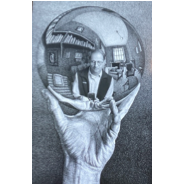
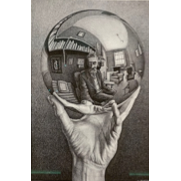
The exhibit has originals of all the well-known prints as well as scores of woodblocks and lithographs I have never seen. But much more than that, the show is wondrously full of interactive moments. Usually I find “interactive moments” in exhibitions, when not broken, something to run from. But these are ingenious. I present just one example here.
The show goes to great lengths to explain the nature of perception in two dimensions and how Escher went about altering that perception.
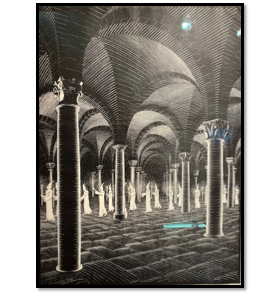
The Dutch-born Mr. Escher notes that his eyes opened and his life changed when he first came to Italy at age 23. Soon thereafter he settled in Rome. It is here he embarked on the puzzles and prints that play with perception. The contrast of light and shadow was quite unlike what he had grown up with and the architecture affected him deeply. There are also many prints in the show that do not attempt to alter perception, they are just beautiful wood cuts, such as Procession Through a Crypt, below.
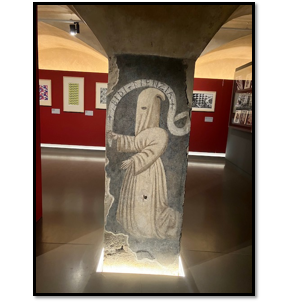
I could go on and on about this show but instead I will just leave you with this. The exhibition is in the crypt of the Spedale. The wood block print you see on the left shows hooded monks moving through a crypt. Well, in the very last room of this show, the columns of the Spedale’s crypt have fifteenth- century frescoes of white-robed monks. Coincidence? I don’t know. But I am sure the curator of the exhibit was pretty thrilled about the serendipity.
I apologize. I find that I have given you the wrong recipe for the Amaro Spritz. It should be: 4 oz. Amaro; 6 oz. champagne or prosecco; 2 oz. seltzer; 1 orange peel.
Arrivederci,
Warren Ashworth
[1] This method of painting was not invented in the Renaissance. The Fayum portraits found on the lids of ancient Egyptian sarcophagi were painted in egg tempera which explains why gazing at them we can feel like they were painted yesterday.
[2] Did you notice that bottle of olive oil in the still life? It has a tag on it that says, “Nuovo Raccolto”. I left it there for you to see. That label means it was just pressed. I never knew there was such a thing as new olive oil. Do they sell it at Fairway? I have never seen it. I have never heard anyone talk about it before this season in Florence. I bought it in my shop that refills my wine bottles (Vino Divino on Via Taddea, fyi). “Oh yes”, the charming young proprietor said, (in the English he told me he learned from watching American television and movies), “it is excellent this year.” Since then, I have heard two other local folks talk about the nuova raccolto. It is excellent this year. This is the kind of new information that makes me feel that Sarah Huckabee Sanders becoming governor of Arkansas maybe just does not matter that much.