Looking up.
Naturally, the longer one resides somewhere, the more one wants to understand its history, and not just the history of five hundred years ago, so it is with interest that I have been reading a book published in 1947. By the way, the Italian word for history is storia. “Historical” is storico. Our English words for this derive directly from the Latin, historia and historical. But, like Eliza Dolittle, Italian doesn’t care for ‘H’s. Thus storia. Which is so close to “story” in English. And, add to that, the Italian word for “story” is also storia. So herewith, a little storia.
Monte Cassino is the one battle of the Italian campaign I remember my father speaking about. Like most of our fathers who were veterans, they were able to share their stories with other veterans, but rarely did they share much about them with family and other friends. Edward Kander, my late father-in-law, and Jason Kander his grandson, are perfect examples of that. Ed and Jason were able to communicate in ways that were very particular to their experience. An experience that those of us who have not been to war cannot fathom. On the heels of the extraordinary Christ Stopped at Eboli that I mentioned in Lettera Nove, which ends just before the Second World War, I have been reading War at Val d’Orcia; a Diary by Iris Origo. Ever since arriving here we have been seeing, as one does, many war memorials on plaques and statues, for both the world wars. But we kept wondering what Italy’s involvement was in these wars. My memory was fuzzy on this. We looked it up and were reminded that in both wars Italy started out on the side of the Axis powers but at the end of each conflict had switched to the side of the Allies.
That seemed mighty odd. The Origo book was recommended to me by someone to whom I expressed my confusion. The diary covers the years of Italy’s transition from one side to the other, 1943 and 1944. The book was published in 1947 and is still available. I am not saying rush out and get a copy, but merely that – for me – it is shining a very clear light on what turned out to be a disastrous transition. Very, very briefly, in the summer of 1943, the King of Italy and his circle had had enough of Mussolini’s dreadful excesses and arrested him and ousted his government with the intention of making a pact with the Allies at the same time. However, the Italians dragged their heels on this armistice for three months, allowing the German forces plenty of time, in the fall of ’43, to entrench themselves all over the Italian peninsula with absolutely no resistance as the Italian army had no orders to act. The Germans even un-arrested Mussolini and re-established Italian Fascists into a shadow government.
Little by little, in January of 1944 the Allies started to work their way north from Sicily routing the German forces as they went, with major losses on both sides of the conflict and tremendous destruction. In Lettera Due, I showed you a painting from the ceiling of the Uffizi depicting the results of bombs set off by the Germans on their way out of Florence, which did not occur until August of 1944.
Origo writes about many battles. The diary entries rely on in-person reports, BBC radio transmissions, letters from friends, and newspaper accounts. She also had first-hand reporting from the prisoners of war, the Germans and later the partisans that were billeted in her large house and farm in the Tuscan countryside. Among those battles, she often mentions the conflict at Monte Cassino. And the memories begin to filter in of Bill Ashworth mentioning that he was deeply engaged in that same conflict. According to other sources I have now read, it took months and months to establish the Allies in the German occupied monastery at the top of Monte Cassino and their losses were horrific. In the end it was considered, by many, a pyrrhic victory.
And here I am, not far away, eighty years later.
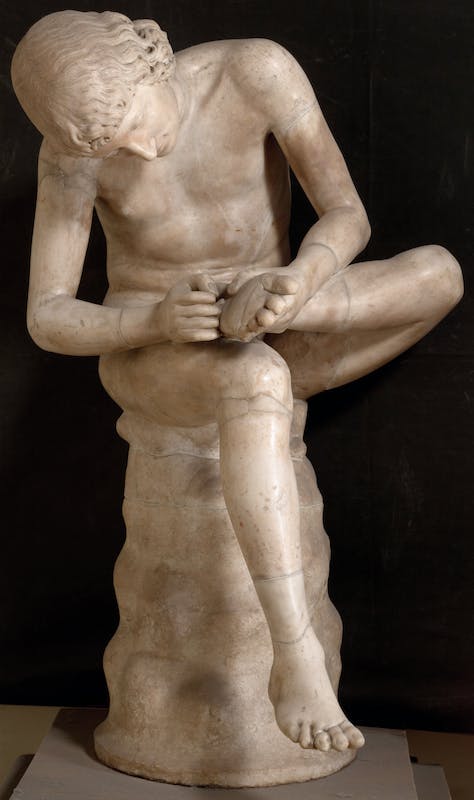
And a more recent storia: before we arrived in Florence certain wives were rather nervous about the overall undertaking but, before we left, she said that the thing most drawing her here, that she most wanted to see again in Florence, was a marble sculpture of the boy taking a thorn out of his foot. She thought she remembered it was to be found at the Accademia and so after seeing Michelangelo’s David, we wandered into the far reaches of the museum but did not find it. Finally, she asked a guard and he said no such sculpture had never been part of their collection. Well, this individual was about two years older than my grandson so his “never” was a pretty short time. We then scoured the Bargello, Florence’s sculpture-centric museum, thinking maybe it had been moved there and though we found this wonderful painting that looks a whole lot like my friend Madeline Nero, we saw no boys taking thorns out of their feet.
I hear all you thirty-somethings saying alright already, just check the internet. So we did. By this time, we have been in Florence for about 7 weeks and certain wives are really pleased with how much they are enjoying being in this town and are even beginning to wonder how it might be if I were invited back next fall. But still, she is determined to find this sculpture that was a high point of her last trip here in 2007. The internet says it has been at the Uffizi since 1857. We have visited three times now and not laid eyes on any thorn-pricked boys. So, we head back late one day when there are very few folks there. We go all around and spend some time looking up. Looking up at the Uffizi is always rewarding, and we unearthed some treasures no one has ever noticed before like this portrait of Gaston Foxius.[1] He is among the hundreds of 17th century portraits of leading men and women, from Suliman to Anne Boleyn, that adorn the upper-most crown-molding of the long corridors known as the Serie Gioviana. Little attention is paid to these, what with the world’s treasures all around and all at eye level. I deeply regret not having made Gaston’s acquaintance before my wife reached menopause as I would have insisted we fire up another boy and name him Gaston Foxius Ashworth. I guarantee you the next novel we write will have a character in it named Gaston Foxius and you, my friends and family, are the first to know.
Still, we hadn’t found Susan’s sculpture. We approach a sympathetic-looking guard and Susan asks him, in very correct Italian, where we might find “Il Spinario” as the internet has informed us the boy taking the thorn out of his foot is called, and it notes that the one in the Uffizi is first century BCE, Roman. “Oh,” he replies, in excellent English, “it is in Boston. It was sent there for an exhibition some months ago”. And so it goes.
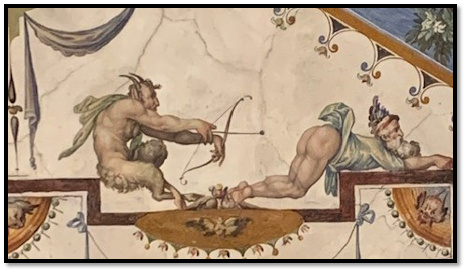
Today, Susan found some amazing discoveries of her own. First, she found a sock store with 100% cotton socks in all kinds of patterns. We now have enough socks that if we were forced to walk across the Russian Steppe we could have a new pair of socks every day and die with clean ones on. Then, she took herself to the Uffizi where, looking up, she found an amazing series of fabulous grotesques (as they are known) on the ceiling of which we send you this gem. These were very much the fashion in the 16th – 17th centuries and every inch of the gallery hall ceilings are covered with them.
She also found this bust of Cicero from the first century BCE. It was dug out of the ground during construction of a Renaissance church. Along with Il Spinario, these were among the Roman and Greek treasures unearthed here that were inspiring the Florentine humanists thirteen and fourteen hundred years later. And they were rediscovering Roman authors, such as this timely tidbit of Cicero’s:
“A nation can survive its fools, and even the ambitious. But it cannot survive treason from within. An enemy at the gates is less formidable, for he is known and carries his banner openly. But the traitor moves amongst those within the gate freely, his sly whispers rustling through all the alleys, heard in the very halls of government itself.” Marcus Tullius Cicero (as recorded by Sallust (c. 40 BCE).
Speaking of authors, we have been waiting to share a little naches until the contract was signed, but now we can tell you that Sam’s book, The Dissection, has been accepted for publication by Santa Fe Writers Project. It will be released in 2025 which may seem like a long time, but Sam is sanguine about it, happy with his editor, and feels that the publisher is committed to doing a first-class job. We did a little danza gioiosa here when the news came in.
And since one can’t have too much Renaissance art, I leave you with this street art from outside one of our favorite pizza places.
Arrivederci,
Warren Ashworth
[1] Duke of Nemours, Captain, killed in action in Ravenna in 1512.