Love and death and food.
Have you read the Inspector Montalbano mysteries by Andrea Camilleri? Or perhaps you have seen the marvelous Inspector Montalbano series on the television. Even the Giovane Montalbano is a delight. If no, I highly recommend them, any and all. Though perhaps mysteries are not your thing. However, if you have not encountered these you may also not have encountered arancini.
Adelina cooks and cleans for Inspector Montalbano, the commissario of a Sicilian city; she is also the mother of two grown sons both of whom are regularly arrested by the police for theft. But they are all very fond of each other and the thefts are petty. But not petty is Montalbano’s love for Adelina’s arancini, a kind of fried-rice ball.
We have read many of these books and seen every one of the television series which have been produced over the course of the last twenty years, but I have never understood much about the arancini and why he is so fond of them. Until this past week. It turns out one can buy arancini here at the Sicilian coffee shop up the block, and other places. I decided to try some. I should not have waited, it turns out they are deliriously delicious.
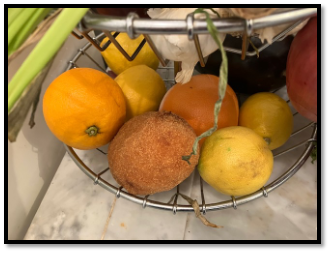
Their name confused me when we got here. Arancia is the Italian word for an orange. Why is this rice concoction named like the fruit. Now that I purchased some and brought them home, dawn has broken over Marble Head. They are round and look just like oranges! Duh. To demonstrate this to you, I have placed one between two oranges in the fruit basket that lives on the kitchen counter at Via Ricasole, 33, and herewith circled it in red.
They are essentially deep-fried cooked-risotto balls stuffed with various delights. And while I am happy to make porchetta for you when I see you, I will not be making any arancini to go with it (though that would be heavenly). I have been researching the recipes and it turns out they are very complicated to assemble. There is a nine-minute instructional video on the internet called I piatti del Commissario Montalbano – Gli arancini if you wish to know how to make them. Holy smokes, Adelina clearly adores this man as this is an all-day affair. I imagine hers are even better than what the Sicilian ladies cook up down the block, but I will stick to buying them, not making them.
Well, you will be thinking about final leftover dishes for your turkey by the time I get this last letter out. Why not consider that Italian favorite, Turkey Tetrazzini, named for the Italian coloratura Luisa Tetrazzini, who, as it happens, was born right here in Florence in 1871. The dish was invented for her by an American hotel chef. Where am I going with this, you ask?
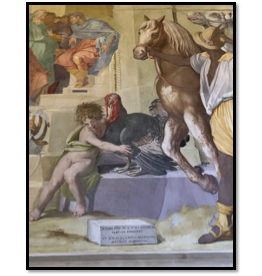
Why right here, to the Medici Villa Poggio a Caiano. We have spent a lovely few days with our French friends Carol and Jacques, who drove down from their home in Apt to be with us. Since they have a car, we got to tour all around the Tuscan countryside to Lucca, Pisa, Montepulciano, Volterra, Pienza and even through the Val d’Orcia, locus of the book I mentioned in Lettera Undici, called The War in Val d’Orcia by Iris Origo. (We were so relieved, as we drove around the hairpin turns of the Tuscan mountainsides, not to encounter any German tank battalions.) One day, we drove out from Florence to Poggia a Caiano, just 45 minutes out of town (longer on a donkey). It is an interesting house in many ways but I bring it to your attention because, as we were hustling to leave, bidding goodbye to our excellent tour guide (I had a class to teach in an hour or so), I spied this turkey. OK, now you probably know that, like tomatoes, turkey is a new-world species. But the date on this fresco is 1582. This is proof that 40 years before the pilgrims landed at Plymouth Rock, and just 90 years after Columbus bumped into the New World, someone had already brought back some turkeys and they had gobbled their way to Florence. And, in fact, Luisa Tetrazzini may have actually sung in this villa and seen this turkey.[1] So go ahead, whip up some of her eponymous dish. But please don’t save any for us. Susan, Sam, Jacob and I dislike it profoundly.
In case you were wondering, Jacques, Carol, Susan and I had Thanksgiving dinner at the Indian Palace Ristorante and toasted (with bottles of Kama Sutra brand beer) our first Thanksgiving with them at our rented house at Aigue Feu, Apt, France, in 1992.
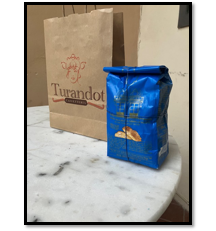
I have a little story for you from Lucca. Susan and I had taken the train there the night before we were to rendezvous with Carol and Jacques. That next day was a stunning, sunny November day, and after touring the kitch-free birth-place and home of Maestro Puccini, we decided to take a moment to do something we have rather overlooked on this Florentine sojourn and that is to sit in cafés at midday and drink. So we settled into the last available table outside, in the sun, at the Turandot Café (yes, of course!) on the Piazza Ho Domenticato. After quite some time, a woman came to take our order. She was an attractive woman, a few years our senior, wearing a stylish outfit as so many Italian women once did but now tend towards jeans and sweatshirts like the rest of us. We sat there chatting and realized forty-five more minutes had passed with still no Cynar spritz, no Aperol spritz, no sandwiches. We reminded each other to be patient and that just sitting in the sun was so nice. But we were thirsty and hungry and the sun had gone behind a cloud and it was getting quite chilly out there. Finally, Susan steps inside to ask after our order. The waitress sees her and says she will be right out. So, the waitress comes out and asks for our order! We are completely puzzled by this and actually give her the same order all over again because, I think, even though Susan knows the Italian for: “What are you, meshuggenah? We already gave you our order more than fifty minutes ago!” she elected not to. Fifteen minutes later, a much younger woman brings our order to the table. I have by this time lost all patience and don’t even thank her. We sluice down our drinks – never seen Susan imbibe so quickly – eat our tramezzini and she goes inside to pay the tab because I know that if I went in, I would not be particularly polite. Susan comes back out and we pick up our things to head back to the hotel and as we do so, the same younger woman comes running out of the café calling, “Signora! Signora!” and pushes a pretty bag of biscotti into Susan’s hands saying, in Italian, that she is very sorry for our very long wait but that her mother is getting very forgetful these days and she just doesn’t know what to do and won’t we please accept this token of her apology.
Never have I been more grateful to have kept my tongue! We were deeply touched. It also gave us a bit of perspective into how Family remains the core, il cuore, to small business throughout this warm land.
Should you get to Lucca, be sure to include a stop at the Turandot Café. Just be sure to order at the counter.
Being here I find I fall in love almost every day. My most recent affair is with this woman on your left. She consumes my days and wakes me at night. Alas, I do not know her name. My comfort is that it appears no one else knows her name either. The title on the frame is simply Ritratto Muliebre, (portrait of a woman) and the painter is my old friend Sandro Botticelli. Scholars cannot agree on the date of the painting. The sitter, who is unknown though broadly speculated about, is not talking. Which makes our relationship simpler, though like Petrarch’s Laura, rather one-sided.
I do not know where she goes at night but I can tell you she spends her days at the Palatine Museum inside the Pitti Palace. Yes, we finally breached the bulkhead of that banal, far-too-big, ugly palazzo to visit some extraordinary capolavori (masterworks) and, with no warning, there she was. I am just not sure I have ever seen a more beautiful painting. At least, this week.
Is she pregnant, you ask? We’re not talking.
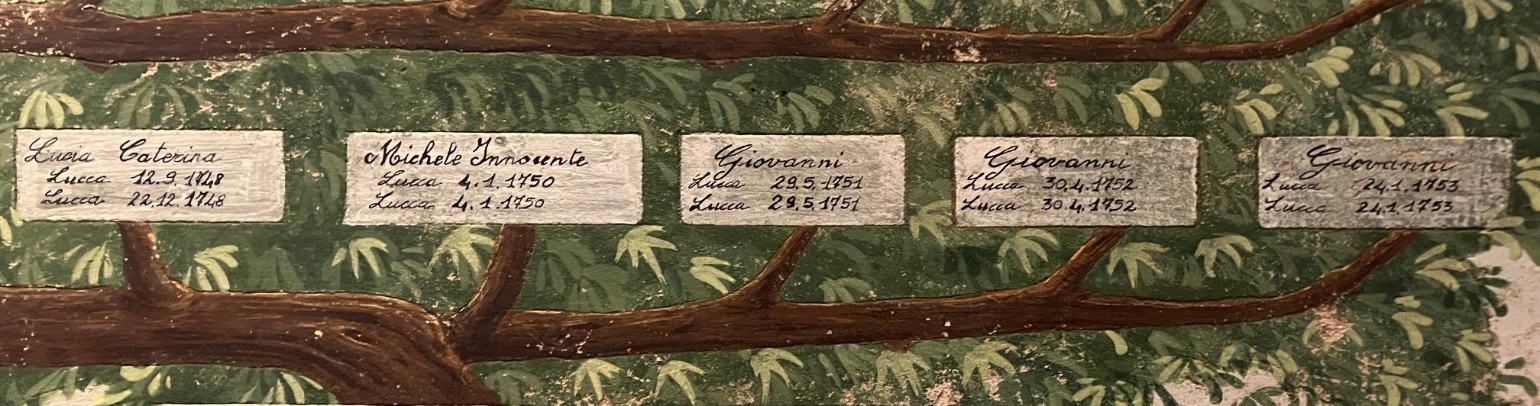
If I sing of love, what of death? For that I bring you back to Casa Puccini in Lucca. We greatly enjoyed our un-guided tour through the apartment where Giacomo was born, raised, lived and worked in his early years. The family had lived in this same apartment for many generations and produced four other well-known composers over five of those generations. Along the way, someone painted this family tree of which I show only one of many branches. If you are reading this on a computer, then you can enlarge the page to read the names and dates if you like. These are the offspring of Giacomo’s great-grandparents. We are all aware of the high rate of infant mortality in the pas,t but seeing it here in green and black and white made it very real. These are just five of Angela Puccini’s eight children. Lucia was born in 1748 when Angela was 26 and she lived three months; two years later Angela had Michele Innocente, who did not live one day; followed by three Giovannis, each about one year apart, not one of whom lived one day. The left side of this tree tells a similar story about her first two infants. Only the third baby survived childhood and went on to continue the family lineage.
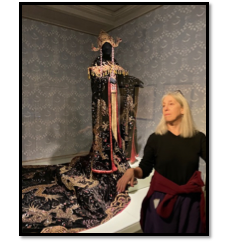
While we are on the subject of lineage, I bring you one more image from the Casa Puccini, this dress worn by soprano Maria Jertiza in the first performance of Turandot at the Metropolitan Opera in 1926. The costume and production were designed by Umberto Brunelleschi. Yes, the great-great-great-great-great-great-great-great-great-great-great-great-great grandson of that Brunelleschi. Here is a picture of the costume in all its glory, taken, remarkably, next to a modern-day opera composer who I found walking around the museum.
Did you know that Madama Butterfly was a flop when it opened in 1904? It was. Reviewers didn’t like it at all. It did not take off until later after he had revised some scenes. So please, all you artists out there who are feeling discouraged that the world is not ready for your work, ignore those critics. The world will be ready for your work soon.
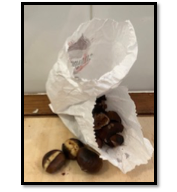
We had been told by some correspondents to these letters to look for roasted-chestnut sellers on the streets of Florence in November and last night, on an outing, Susan finally encountered one. It has been a warm fall but the weather has finally turned chilly so they are beginning to appear, and with them comes an amazing innovation! Two paper bags glued together. One is for the fresh, hot, chestnuts, the other is for their shells so people do not drop them on the sidewalk. It is simple and ingenious and cleanly. This is, in fact, the cleanest city we have ever visited. Have I mentioned that the streetsweeper comes up Via Ricasole every single night at midnight, sometimes twice, but always at the same time? By day, one often sees municipal employees deploying brooms and trash does not linger on the sidewalk. It is kind of surprising and very welcome. Unlike New York City, there is no sign of the animals that transmitted devastating disease here so regularly five, six and seven hundred years ago.
I wish to thank you all for your enthusiasm. It is what kept these letters going. This is my sign-off as we head back to that self-same city in two days.
Arrivederci,
Warren Ashworth
[1] It was occupied by Italy’s King Victor Emmanuel III at the time, and he often had lavish parties with entertainment.