Lettera quindici
There is a secret garden here.
The first time I discovered this secret garden, as happens with the character Mary Lennox in Frances Hodgson Burnett’s book of the same name, I found the gate to the garden alluring – and locked.
Then, I went a second time and found the gate unlocked but the ogre guarding it would not admit me.
Eventually, like Mary, I found the key, and the garden is glorious.
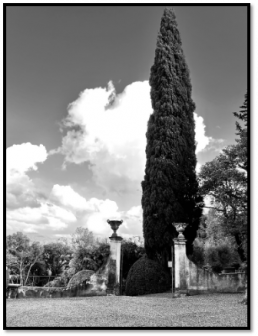
Secret. No, it is not really secret. But not many people seem to know about it. I first realized it was there when I looked up from the Della Grazia Bridge and saw a magnificent esplanade of stairs marching up the steep hillside that comprises much of the topography of the Oltrarno. On one side of the stairs were orchards and on the other, a forest. I assumed this was someone’s private garden. Well, the fact is, for quite some time it was. Just two years after Hodgson published The Secret Garden in 1911, the Florentine art dealer Stefano Bardini purchased an enormous run-down villa and garden, close to the famous Boboli Gardens. I have written here previously of these Boboli Gardens, which I quite dislike. They are relentlessly formal and have not an ounce of romance or delight.[1] But not so the garden next door, known as the Bardini Gardens.
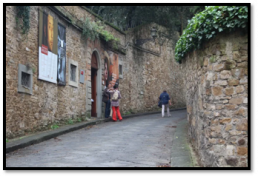
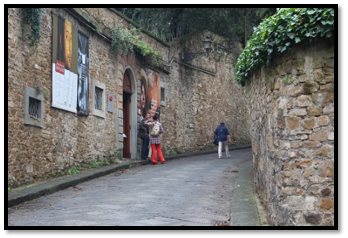
On that first visit, I climbed a very steep, winding, tucked-away street called the Costa San Giorgio. There I found a narrow gate in the middle of an enormous stone wall. I remember it was a Monday. And at the locked entrance to the Giardino Bardini there was a sign that said “Aperto tutti i giorni”. Just as my guidebook had stated. But then, at the bottom of the sign, in very small letters, was a message that translates as: “Closed first and last Monday of the month”. The next time I went, arriving at the gate winded and sweating, the loutish I’m-keeping-this-job-for-life guard at the door would not sell me a ticket as the garden would close at four o’clock. There was no admittance after 3:00 pm. I looked at my watch. It was 3:01. My Italian is terrible. Which was a good thing in this case as I might have said some things that would not have improved his impression of Americans. After that, I went on a Tuesday morning, gained entry, and found an entrancing treasure with all the aspects of an Italian villa garden that one might hope for. The formal stair, the orchard, the loggias, the winding paths through the woods, the belvedere, the stream, the wisteria covered pergola, statues half hidden in the greenery, and a wonderful smell of boxwood, bay laurel and damp earth.
I have been back to this garden with my beloved twice and we find it an amazing oasis in this otherwise treeless city. One that happens to have a sublime view of the city of Florence. But it has something else, something also hidden in plain sight. Within the garden walls sits a dramatic sixteenth-century villa that, followin his restorations, had been Bardini’s home for the few years until his death in 1922. It has a nice little café. But that is not the surprise. There are nice little cafés everywhere here, even on the third floor of the municipal library. No, the surprise lies up a flight of stairs and down a long hallway. It is there you will find the Museo Annigoni. A startling permanent collection of the paintings and exquisite drawings of a twentieth-century Florentine, Pietro Annigoni. We had never heard of him but when I saw this portrait of Queen Elizabeth, it seemed familiar. It turns out that Annigoni (1910-1988) was a much sought after portraitist who was commissioned to paint many heads of state, including John Fitzgerald Kennedy, Lyndon Johnson, Pope Who-ha, and a second, majestic full-length portrait of Queen Elizabeth fifteen years after this one.[2]
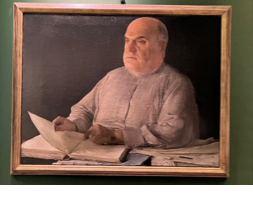
Annigoni was trained in the Italian Renaissance painting traditions that are still very much the curriculum of Florentine art schools today, indeed they are the basis of Susan’s painting class experience last week. Among his work, the most compelling to me was this portrait of his father with whom, the catalog says, he had an exceptionally difficult relationship, and who dismissed his son’s interest in painting as a waste of time. This painting, by the way, is done in tempera. Annigoni and Andrew Wyeth were among the small handful of mid-twentieth century artists who worked in this extremely challenging medium. It happens that the word tempera goes back to Latin temperāre “to moderate, bring to a proper strength or consistency by mixing”. Thus, the same root as in our word “temper”. The laborious process of tempera painting consists of putting down layers of color. Each layer of the painting must dry before proceeding with the next.
Just this weekend I was with our friend Jacques who has taken up tempera painting and was describing the arcane process to me. He is planning to retire soon and is delighted to be engaged in a medium that requires bucketloads of time as he feels that is just what he will be faced with.
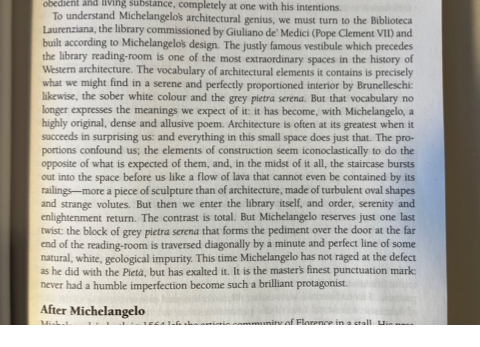
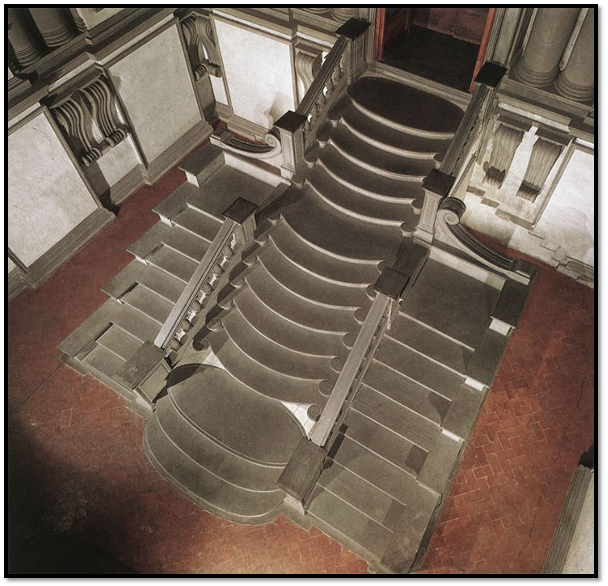
Michelangelo’s Laurentian Library is no secret but it is damn hard to get into. Unless you are a scholar who requires access, there has to be an active exhibit in their small exhibition space in order for them to open it to the public and the last time it hosted an exhibit was before Covid. Well, an exhibition about cocoa just opened and so, with the assistance of my host school SRISA, Professoressa Mohr, our students, Susan and myself were able to gain access this week. If you are not familiar with the library, then there is no more eloquent description of this astonishing series of spaces than what I found in the Blue Guide to Florence, 10th edition, page 31.
These words were written by the brilliant British-born author of The Blue Guide to Florence, Alta Macadam. She is a scholar who lives in Florence and knows the art and architecture intimately. The Blue Guides, if you are not familiar with them, are published for Paris, London, Greece, Crete and other places where art abounds. They list no restaurants, no hotels and no places to shop. They survey only the art and the architecture. The guide includes some of the most obscure places.
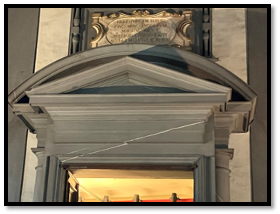
I love her line about the “master’s finest punctuation mark” and couldn’t wait to see it. I was not disappointed. It runs through the great door’s pediment like a lightning bolt as seen in my photo to the left.
Florentines have so much art and share so much of it with so many tourists, you can’t blame them for keeping a few secrets for themselves, or at least making you work for it.
-Warren Ashworth, Florence
[1] This did generate some spirited mail back at me last year from those of you with wonderful memories of the Boboli Gardens from past visits to Florence. Mine appears to be a minority opinion.
[2] Would it interest you to know that this portrait was commissioned by the Worshipful Company of Fishmongers? And that it is displayed in Fishmongers Hall in London to this day and where you may, presumably, visit it if you are a member of that particular guild.


Lettera quattordici
Reaching For It.
We are seated at the Café Brunellescho in the shadow of the Ospedale degli Innocenti and a few footfalls from where Susan is enrolled in painting classes. The food at this trattoria intima is some of the best we have found here but more importantly, the people who run it are lovely. We are sitting outside, eating a really delicious meal and taking in the waning autumn sunlight. A rotund Roma woman is making the rounds of the tables, asking for spare change. When she gets to us we decline and continue with our lunch. I do not care to be importuned while dining. After some minutes she comes back around and asks us for the bread that accompanies all meals here – tasteless, saltless, difficult bread that is a Florentine staple. This pane Fiorentino always carries a subtle message that says yes, we know tourists come here by the millions every day but we are not going to change a 500 year tradition of saltless bread just to make you feel good. This is the bread of affliction, tourists: suck it up.
Anyway, the Roma woman appears to have no such grievances about the bread and asks us for some. I gladly give her ours and she moves away. I continue enjoying my spezzatino di manzo, chunks of tender braised beef. But before I know it she is back, mumbling in her own language, and we watch as – almost in slow motion, zoomed in – her weathered hand reaches across our little round cafe table and she grasps in between thumb and forefinger the largest, juiciest of my pieces of beef. Delicately withdrawing it and placing it in a napkin, she trundles calmly off into Via degli Alfani. Ah well. I imagine she found it as delicious as I did.
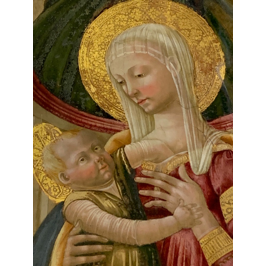
I enclose herewith another lovely example of Reaching For It. This one is from a painting by Neri di Bicci from 1472. Susan found this in the tiny museum directly across the street from our apartment, the Cenaculo Sant’ Appolonia, which houses a sublime last supper. These cenaculi, huge frescoed murals of the last supper (il ultima cena), were the traditional adornment that graced the wall above the head table in refectories throughout Florence and other cities. The most famous one, of course, is in Milan, by Leonardo Da Vinci.[1] There are 37 still extant in Florence and many more are long gone. This gives you some idea of how many monasteries this city hosted, each one with 50 to 100 monks or nuns. If you consider that by 1347, with the monastic movement surging, the population here was about 110,000, you get some sense of their presence.[2]
I touched on this particular Cenaculo in a previous letter. But I was always so occupied by the delights of the fresco that I failed to pay much attention to the four ancillary paintings in the vestibule of the museum, until Susan brought this painting to my attention, featuring a clearly age-old gesture.
One thing it turns out you should not reach for is something mentioned in my Lettera Tredici. It turns out there is a reason you have probably never encountered black chickpeas. After soaking them properly for a day and cooking them gently, without salt (which you should never use in cooking chickpeas as it retards the softening process), for the requisite time, I found they tasted like little balls of construction paper. Black construction paper.
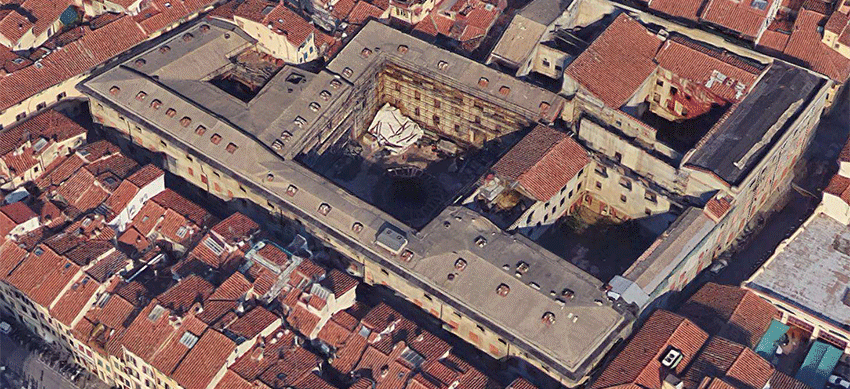
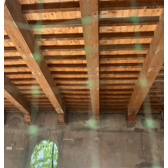
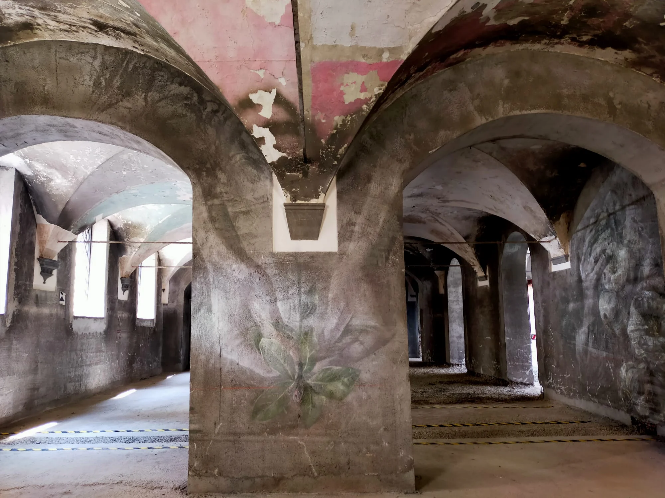
Sant’ Orsola is an enormous former Benedictine convent in the center of Florence that at its peak had more than 300 occupants. An abandoned shell for the last 60 years, it dominates the San Lorenzo neighborhood of Florence. It is comprised of a series of buildings which surround four different cloisters, as you can see above. It is within this shell that my students here have the opportunity to design. They are given the floor plans of this massive complex in AutoCAD (a drafting software) and whatever project they are working on they must design it to fit into some part of the space. This is part of what makes being a student here an experience they will remember all their lives. Because, yes, being in Florence and taking classes here for a semester or two is fabulous and memorable, but actually getting to understand – at a micro-scale – the nature of a building begun in 1309 affects how one thinks about space for the rest of one’s career. Their designs must take into account the building’s existing interior 18” thick partitions; its wooden beams that measure 12” wide by 26” deep; its floors made of either massive stones or, on the upper floors, terra cotta that is hundreds of years old; its groin vaults; and its 30” thick exterior walls with arched windows that are simply enormous. And they have to work entirely in metric, which takes a few weeks to get used to. Above, left and right, are typical views of the bewitching interior of this building, currently inaccessible.
Normally my students back at The New York School of Interior Design are working within New York City buildings where the interior partitions are 5-1/2” thick, where the wood beams, if there are any, are 3 x 12s, where the ceilings are low and flat, the floors poured concrete, and the windows always rectangular. We don’t even teach students back home how to draw groin vaults. And, as any one of them will tell you, those of my students here who have to do so face an extremely complex undertaking. Especially in three-dimensions.
The point is, working at this granular level in a building unlike any the students have ever encountered inspires creativity. But such a building also makes demands. Working in this ancient skeleton of a building the obligations of preservation are always at hand coloring every decision, provoking unexpected solutions.
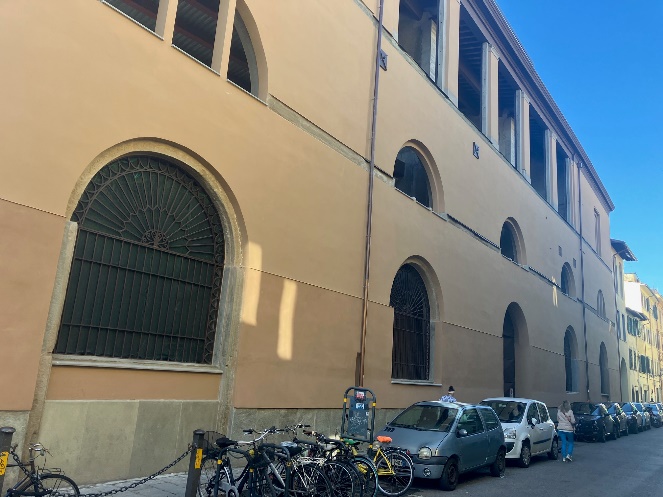
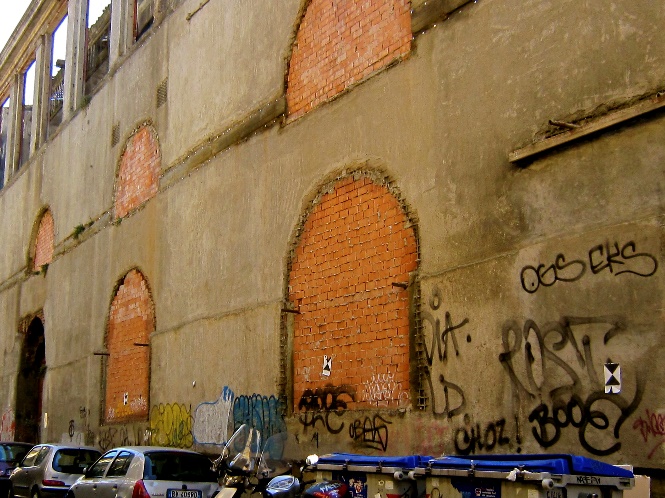
The images below are of the exterior of Sant’ Orsola, on the left from last November and on the right, yesterday. The building is finally being restored and in a few years, once stabilized, will be a great example of adaptive reuse with a wide variety of tenants. It is being done under the aegis of a private French firm[3]
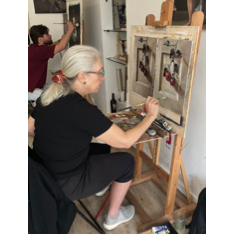
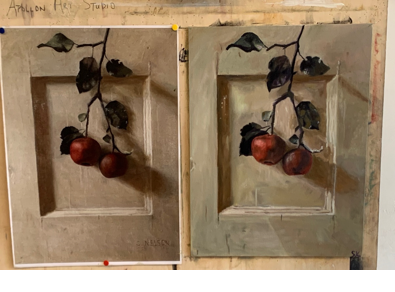
On Friday this week, Susan completed her painting and drawing class at the Apollon Studio here in Florence, the center for the teaching of classical techniques. In the course of five short days she did chromatic color studies, pencil drawings of forms such as spheres, cones, cubes and the ever-challenging egg shape. With oil paints in hand and an excellent teacher at her shoulder, she set about copying a painting – a classic teaching tool. It took her four days and I think the resulting work, on the right, is just astonishing. I am molto orgoglioso of her. Orgoglioso. A delicious, euphonious word. It means proud. Think agog. Which is what I am.
During our time here it has become clear how seriously the Florentines approach the act of making art. There are many, many schools of painting here, schools of sculpture, schools of etching and water coloring and drawing and the general through line is that foundational techniques are still considered of paramount importance. This is sooo unlike American art schools of my experience where you “paint what you feel” and heaven forfend anybody should actually have to learn under-painting, glazing, shading, or anatomy. Here they have not forgotten the centuries-old lesson that craft matters. And starting with a foundation of basic technique is a great way to be free to “paint what you feel”. Susan’s feelings are displayed on the right. I think her taking this up is a perfect example of wanting to learn something new and reaching for it.
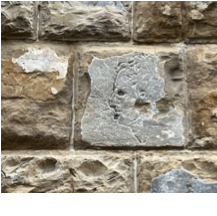
Now this below is something to look for next time you are here. There have been a few articles about a recent discovery that basically proves a local legend to be true. On the outside of the Palazzo Vecchio there is a face that very few people ever notice even though it is right at eye level. The face is sketched into the smooth stone, done by someone very gifted with a stone chisel. Here it is:
Since the 1500s, locals have thought this to be a Michaelangelo carving, done about the same time his David was originally installed just a few yards away. But there were no eyewitness accounts of his carving it.
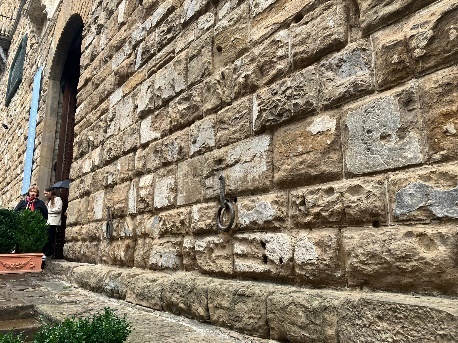
For context, here you see it near the front door of the Palazzo. Just two years ago a researcher in Paris found a Michelangelo drawing on paper of this very face. For those who have noticed it over the years, it is one small mystery resolved.
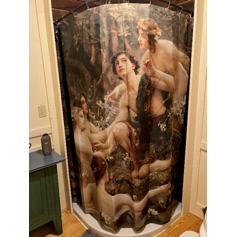
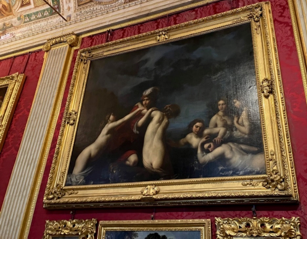
Last week’s Lettera Tredici spoke of visiting old places and seeing new things as happened when we went to the Palatine Gallery in the Pitti Palace for our second time. There I found a Hylas and the Water Nymphs high up on a wall. I am only recently acquainted with Hylas because of a shower curtain I bought on the internet on which he is featured. This past June I completed all the work on the bathroom in our Stone Ridge barn. I have spent the last year converting it into a studio and guest house. It was clear that the finishing touch called for was a shower curtain with verve. And voila! I felt that water nymphs gracing a bathroom seemed very suitable but really, I had no idea who this Hylas was.
My curiosity was piqued by the sight of this other Hylas at the Palatine. So I did a bit of research and discovered that most interpreters of Greek myths acknowledge the “beautiful, curly, blond-haired Hylas” was one of Hercules’ lovers aboard the Argonaut. At a moment when Hercules was not paying attention, the water nymphs, who had been admiring this young man from beneath the waves, swarmed over the gunwales, reached out for Hylas, and made him their own. Hercules searched so long for his lost lover that the Argonaut sailed off without Hercules, in pursuit of the Golden Fleece which I really can’t remember what that was and why they were so hot for it. Herc never saw Hylas again, so goes the legend.[4]
The lesson this week is reach for what you really want. You might get it – and it might taste really good.
[1] My opinion, which you have not asked for, is that while this particular Cenaculo is good, it is no better than some here in Florence.
[2] By 1350, that population was approximately 55,000 due to the ravages of the first great plagues.
[3] Which is ironic in that it was the French – who, under Napoleon, ruled Florence at the time – that closed almost all the monasteries in Tuscany between 1808 and 1810 in what is known as the suppression. It became a tabaco factory after that.
[4] According to Plutarch and Aristotle, apparently. Also, the poet Theocritus (about 300 BC) wrote about the love between Hercules and Hylas: “We are not the first mortals to see beauty in what is beautiful. No, even Amphitryon’s bronze-hearted son, who defeated the savage Nemean lion, loved a boy—charming Hylas, whose hair hung down in curls”.
Lettera tredici
Irony: “From the Greek eironeia – an incongruity between what might be expected and what actually occurs”.[1]
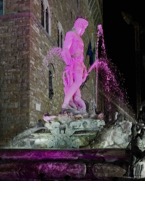
Yes, it turns out that October is also Breast Cancer Awareness month in Florence. Among other venues, it is being celebrated at Neptune’s Fountain in the piazza della Signoria in front of the Palazzo Vecchio.[2] Here Neptune is surrounded by satyrs, each of whom is a comfort to him as he celebrates this special month.
And, yes, we are back in Florence, arriving just in time for the last day of Breast Cancer Awareness month. Our oncologist, who was herself born in Bologna, felt that nothing could be more recuperative than five weeks in Florence.
I am not denigrating the importance of this month of awareness. Far from it. Susan and I are both quite aware that, despite her lifelong antipathy to the color pink, the medical knowledge, the level of care, and the positive experiences we have encountered within today’s breast cancer universe owe much to the initiatives that Susan G. Komen’s sister started all those decades ago. I merely find it amusing to see Neptune all in pink.
It is remarkable being back in a place we felt we knew well. There are still many streets we have not walked down, and many things to see for the first time on the streets we thought we knew. The first day is brutish, of course. One simply tries to keep one’s eyes open, walk a lot to avoid having a nap and to get acclimated to the time zone.
On that first day, after getting acquainted with our pleasant apartment on the Via XXVII Aprile, we went to a local grocery to lay in basic supplies for breakfast.[3] We had a dinner with a friend here, a colleague of mine at the local host school. Someone we like very much. She invited us to the very same restaurant that she brought us to a year ago, for what was then our very first dinner. I am sure the Germans have a word for doing the same thing in just the same place at just the same time, a year apart. Feel free to send me that word.
The night was restful thanks to various prescription drugs and we woke up with the sun, feeling rested. If you don’t have good drugs you will lose valuable time here. Make sure your doctor is indulgent in this regard and if they are not, consider finding one who is. Brevi ferarum; sunt multi doctores – Vacations are short, doctors abound.
In the morning we went to the café downstairs and had our first frothy cups of cappuccino. Looking back at my previous twelve letters I find that I have barely mentioned the coffee here. An omission. The coffee in Italy is ambrosia. Remembering your first kiss is something we can look back on and that reflection is a lovely thing (well I hope it is a lovely thing for you). The beauty of coming back to Italy after any length of time is that the morning cappuccino you drink is just like the first one you had when you first fell in love with Italy. And if you haven’t been here yet, you can just tell yourself I am exaggerating. But I will offer you this: if your first kiss really wasn’t that good, or if it was really yucky and gag-me-with-a-spoon bad, then just come here, stand at the counter of a café and all that will be put behind you with your first sip.
We wandered over to a merceria, (housewares store), and picked up a few things the apartment lacks plus some pantofoles (slippers) for Susan. I have been to this particular store often and while not customary for mercerias, this one stocks dried legumes and flours in big burlap sacks. In keeping with the note that one sees new things while walking down familiar streets, I was excited to discover cecchi nero – black garbanzo beans – for the first time. I can’t wait to soak them and see what becomes of them.
Before we left New York I found my old copy of The Agony and the Ecstasy, Irving Stone’s 1961 book about Michaelangelo. I read it about twenty-five years ago. I find I remember so little of it, it is a pleasure to read again. Michaelangelo was raised in Florence and the book is an excellent digest of his early years here. At fourteen he is invited by Lorenzo di Medici to join a school for sculptors led by Bartoldo, a sculptor who was Donatello’s assistant. Their work yard and shop were in a Medici garden across the street from San Marco (two blocks from our apartment). Before long, Lorenzo, recognizing the teenager’s genius, invites him to move into the Medici Palace, known now as the Palazzo Medici Riccardi, and become an extended member of the family. Stone describes a very close relationship with Il Magnifico himself. The year is 1488 and Savonarola is worming his way into the social and cultural life of Florence where, in a few short years he will be the head of the “new” republic.
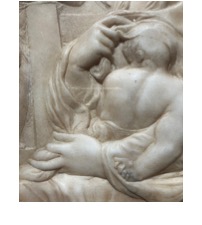
The first three sculpted works of the young Michealangelo are still here in town, two at the dowdy museum called the Casa Buonarroti which I mentioned briefly in Lettera Dieci. The Madonna of the Stairs, as she is known, is his first completed work in marble. He was fifteen. It is the first ever image of the Christ child with his back fully to the viewer and it is the first to put the Madonna in a quotidian setting with his BFF John the Baptist playing around on the stoop. Stone’s book makes clear that the artist was thinking independently even in his earliest years.
The third sculpture we know of is at Santo Spirito, a wooden crucifix shown in Lettera Nove, made when he was 17 as a gesture of thanks to the Prior there who allowed the sculptor to do dissections of the indigent dead deep at night, in secret. If he had been caught, Michaelangelo would have been executed and the prior excommunicated. The book is just a magnificent, scholarly, and fascinating novelization of his early years here before going to Rome, where he spent most of his life. If it is gathering dust on your bookshelf and you are considering putting Florence on your itinery, don’t leave home without it. Our great fortune is that we can now go back to these two places and visit the work again, knowing a little more than we did before.
I know you are wondering, so yes, we have been to see my ortolana, Rita, at her stall in the Mercato. No, I did not take any pictures of her. That would not suit at all. She was pleased, perhaps, to see me and surprised a year had passed already. To Susan’s delight, both green and purple figs are still in season. We also bought artichokes on long stems, clementines, greens, the local green and red radicchio, stunning tomatoes, and herbs. When everything was tallied she gave us a pomegranate “per buona fortuna”. We then moved on to the lateria I favor, where the lovely female half of the couple who run it has always welcomed me with a lovely smile, and bought three kinds of salami, plenty of porchetta, mozzarella, and hunk of three-year-old parmesan cheese.
Perhaps we have the pomegranate to thank for what happened the next night, the night of Ognisanti – All Saints. November 1st. All the churches (and cemeteries) open on this national holiday, giving us the opportunity to visit the church at San Marco, so close by. I have described the museum at San Marco before, where Fra Angelico’s magnificent Annunciation is to be found and where one may visit the cells occupied by the evil Savonarola until his gruesome demise. Last year the church itself was not open due to construction in the piazza so we were delighted to be able to go in. It is a fairly simple, hypostyle church without side chapels and with very little ornamentation as befits the Dominican Order of monks who inhabited San Marco Monastery for five-and-a-half centuries.[4] There were about ten people there and organ music was playing. But, instead of the canned atmospherics you often hear in churches, it quickly became apparent that someone was playing, really playing. The organist, tucked behind fat columns at the side of the altar space, was clearly improvising, playing from the heart. It was stunning to hear the flow of what Susan describes as “uncomplicated, broad, gently emotional sound landscapes” in this large but comparatively simple space instead of the usual highly decorated, stylized, thumping or four-square exhortational stuff. We sat in the old hard pews in different parts of the church. We listened and I sketched. The man played on for over ten minutes, volume and density rising and falling, major and minor, questioning and answering, doubting and glorying, but simple simple; and then, with a final long, grand sonority of closure, the space was silent. The organist stood up, put on his jacket, picked up his satchel, and headed out into the wide nave of the church toward the front door. Susan intercepted him to thank him, and I saw her chat briefly with him. She told him how beautiful and personal his improvising was – “Yes, that is just my own music,” he confirmed, quite bashfully. She told him that it was her mother’s birthday, her mother che è morta, and grazie tanto, suona bellissimo. The next thing I saw from across the nave was that, instead of continuing toward the door of the church, the man turned around, walked calmly back up onto the altar, took off his jacket and put his satchel back down, whereupon we and the three people left in the church were treated to another fifteen minutes of exquisitely humanistic music.
I should explain that my wife generally detests organ music. She says this is the first time she has ever heard the instrument played in a church setting that seemed to put Religion completely aside (aided because the cross suspended over the altar was only a representation without a corpse dripping blood). Instead, it was simply one person speaking from the heart in his own deeply personal language to and for all. A full meal.
After that sublime and, for Susan, deeply emotional experience, we walked over to the Piazza SS. Annunziata, where is to be found the Ospedale degli Innocenti, as I have described before. This perfect night the piazza was ever so quiet and the sky was a blue-like blue, so blue as to redefine blue. We walked up to the Caffè dei Verone on the top floor of the Ospedale for an aperitif. In my very first letter I wrote about this incredible café in the old laundry loggia on the top floor of the orphanage designed by Maestro Brunelleschi. Not only was the man brilliant with his never-before-seen façade, but his back-of-the-building, quotidian, open-air laundry-drying area is a work of art. Anyway, the orphans and their sheets and gowns and diapers are all gone but this is still the view.
So, yes, we have been here before. Part of the joy of learning a city well is returning to the places that brought you joy. And it is why we are sometimes less keen on setting off for places unknown.
To that end, we were very lucky to be invited by Professoressa Cynthia Mohr, the friend mentioned above, to a gathering of her women’s circle to hear a talk by one of its members, Elizabeth Wicks. In Lettera Dieci I explained that Ms. Wicks is an American art conservator of the first water. A year ago, we went to see her beginning the restoration of a grievously dilapidated Artemesia Gentileschi painting that has spent its last 408 years at the aforementioned Casa Buonarotti bolted into a ceiling panel for which it was commissioned by Michelangelo the Younger, the Maestro’s great nephew. Italy – to its credit – has made it a policy that the process of restoration of great works should be, when possible, viewable by the public as opposed to happening behind the scenes. I provide herewith the before (in process from a year ago) and the after (which we saw yesterday).
Ms. Wicks spent a couple of hours talking about what was involved in this restoration as well as speaking about the life of the astonishing Ms. Gentileschi. The finished restoration of the panel, known as The Allegory of Inclination, is the centerpiece of a brand-new exhibition at the Casa Buonarotti. Part of the exhibition includes another astonishing work by the artist on loan from the Palatine Gallery in the Pitti Palace (where we were on Thursday) done a year after this called The Penitent Magdalene. If you are not familiar with the life story of this painter then you need to be. I am sorry to be demanding but that is just a fact. To understand her Judith and Holofernes, her Magdalenes, her Susanna and the Elders, her Allegory of Inclination, you need to know a bit about what this individual went through in her life.
Why?, you ask. Do I have to know about the lives of Henri Matisse, Édouard Manet, or Kieth Haring in order to enjoy their work?
No, I reply.
Well, is this some feminist claptrap you are insisting on? Just because she is a woman painter, I have to know about her?
No, I reply. Henri Rousseau. Jean-Michel Basquiat. Edvard Munch. Those are men who you need to know something about to best appreciate their work. Likewise Artemesia. No whining. Go look her up.
She was 17 when she painted her Susanna and the Elders which is a masterpiece. She was 21 when she moved to Florence from Rome and painted this Allegory of Inclination. She painted The Penitent Magdalene a year later. Wicks confirmed that the women’s faces in most of Gentileschi’s paintings are reflections of her own facial features if not outright self-portraits.
So now she has a special exhibition all her own showing work from her earliest years, an exhibition mounted in a house that celebrates the early work of another gifted artist who also started very young. While there I took a detailed photograph of Michelangelo’s bas relief Madonna della Scala to share with you. I invite you to compare the brilliant representation of hands in both works. Even the hand of the child in Mary’s lap is exquisitely carved.
One artist has been well known and admired for centuries. The other, finally, in the last generation, is taking her richly-deserved place in the pantheon. How fitting that the latter is being celebrated in the casa of the former. How exceptional to be with them together.
Warren Ashworth – Florence
(One note: I make reference to past letters. These may now be found at www.WarrenAshworth.com/Letters)
[1] Quotation from We, the House by Ashworth and Kander, page 1.
[2] Designed by Baccio Bardinelli and completed in 1574, commissioned by Cosimo 1 de’ Medici in 1569.
[3] I do not yet know what happened on the 27th of April that it is celebrated with a street name, but I will find out and be sure to let you know.
[4] Hypostyle simply means the ceiling is flat, not vaulted or peaked. There were Dominican friars using the monastery all the way until 2014, in the western part of the building not designated for the museum.


Lettera dodici
Love and death and food.
Have you read the Inspector Montalbano mysteries by Andrea Camilleri? Or perhaps you have seen the marvelous Inspector Montalbano series on the television. Even the Giovane Montalbano is a delight. If no, I highly recommend them, any and all. Though perhaps mysteries are not your thing. However, if you have not encountered these you may also not have encountered arancini.
Adelina cooks and cleans for Inspector Montalbano, the commissario of a Sicilian city; she is also the mother of two grown sons both of whom are regularly arrested by the police for theft. But they are all very fond of each other and the thefts are petty. But not petty is Montalbano’s love for Adelina’s arancini, a kind of fried-rice ball.
We have read many of these books and seen every one of the television series which have been produced over the course of the last twenty years, but I have never understood much about the arancini and why he is so fond of them. Until this past week. It turns out one can buy arancini here at the Sicilian coffee shop up the block, and other places. I decided to try some. I should not have waited, it turns out they are deliriously delicious.
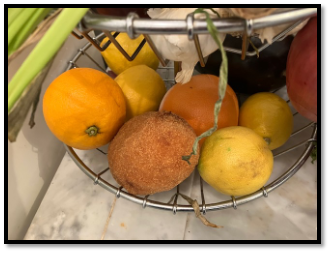
Their name confused me when we got here. Arancia is the Italian word for an orange. Why is this rice concoction named like the fruit. Now that I purchased some and brought them home, dawn has broken over Marble Head. They are round and look just like oranges! Duh. To demonstrate this to you, I have placed one between two oranges in the fruit basket that lives on the kitchen counter at Via Ricasole, 33, and herewith circled it in red.
They are essentially deep-fried cooked-risotto balls stuffed with various delights. And while I am happy to make porchetta for you when I see you, I will not be making any arancini to go with it (though that would be heavenly). I have been researching the recipes and it turns out they are very complicated to assemble. There is a nine-minute instructional video on the internet called I piatti del Commissario Montalbano – Gli arancini if you wish to know how to make them. Holy smokes, Adelina clearly adores this man as this is an all-day affair. I imagine hers are even better than what the Sicilian ladies cook up down the block, but I will stick to buying them, not making them.
Well, you will be thinking about final leftover dishes for your turkey by the time I get this last letter out. Why not consider that Italian favorite, Turkey Tetrazzini, named for the Italian coloratura Luisa Tetrazzini, who, as it happens, was born right here in Florence in 1871. The dish was invented for her by an American hotel chef. Where am I going with this, you ask?
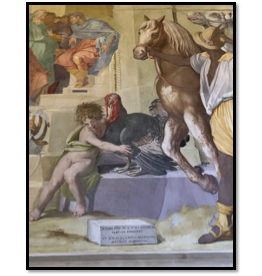
Why right here, to the Medici Villa Poggio a Caiano. We have spent a lovely few days with our French friends Carol and Jacques, who drove down from their home in Apt to be with us. Since they have a car, we got to tour all around the Tuscan countryside to Lucca, Pisa, Montepulciano, Volterra, Pienza and even through the Val d’Orcia, locus of the book I mentioned in Lettera Undici, called The War in Val d’Orcia by Iris Origo. (We were so relieved, as we drove around the hairpin turns of the Tuscan mountainsides, not to encounter any German tank battalions.) One day, we drove out from Florence to Poggia a Caiano, just 45 minutes out of town (longer on a donkey). It is an interesting house in many ways but I bring it to your attention because, as we were hustling to leave, bidding goodbye to our excellent tour guide (I had a class to teach in an hour or so), I spied this turkey. OK, now you probably know that, like tomatoes, turkey is a new-world species. But the date on this fresco is 1582. This is proof that 40 years before the pilgrims landed at Plymouth Rock, and just 90 years after Columbus bumped into the New World, someone had already brought back some turkeys and they had gobbled their way to Florence. And, in fact, Luisa Tetrazzini may have actually sung in this villa and seen this turkey.[1] So go ahead, whip up some of her eponymous dish. But please don’t save any for us. Susan, Sam, Jacob and I dislike it profoundly.
In case you were wondering, Jacques, Carol, Susan and I had Thanksgiving dinner at the Indian Palace Ristorante and toasted (with bottles of Kama Sutra brand beer) our first Thanksgiving with them at our rented house at Aigue Feu, Apt, France, in 1992.
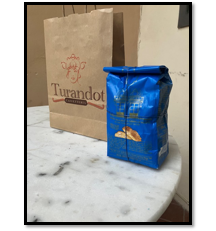
I have a little story for you from Lucca. Susan and I had taken the train there the night before we were to rendezvous with Carol and Jacques. That next day was a stunning, sunny November day, and after touring the kitch-free birth-place and home of Maestro Puccini, we decided to take a moment to do something we have rather overlooked on this Florentine sojourn and that is to sit in cafés at midday and drink. So we settled into the last available table outside, in the sun, at the Turandot Café (yes, of course!) on the Piazza Ho Domenticato. After quite some time, a woman came to take our order. She was an attractive woman, a few years our senior, wearing a stylish outfit as so many Italian women once did but now tend towards jeans and sweatshirts like the rest of us. We sat there chatting and realized forty-five more minutes had passed with still no Cynar spritz, no Aperol spritz, no sandwiches. We reminded each other to be patient and that just sitting in the sun was so nice. But we were thirsty and hungry and the sun had gone behind a cloud and it was getting quite chilly out there. Finally, Susan steps inside to ask after our order. The waitress sees her and says she will be right out. So, the waitress comes out and asks for our order! We are completely puzzled by this and actually give her the same order all over again because, I think, even though Susan knows the Italian for: “What are you, meshuggenah? We already gave you our order more than fifty minutes ago!” she elected not to. Fifteen minutes later, a much younger woman brings our order to the table. I have by this time lost all patience and don’t even thank her. We sluice down our drinks – never seen Susan imbibe so quickly – eat our tramezzini and she goes inside to pay the tab because I know that if I went in, I would not be particularly polite. Susan comes back out and we pick up our things to head back to the hotel and as we do so, the same younger woman comes running out of the café calling, “Signora! Signora!” and pushes a pretty bag of biscotti into Susan’s hands saying, in Italian, that she is very sorry for our very long wait but that her mother is getting very forgetful these days and she just doesn’t know what to do and won’t we please accept this token of her apology.
Never have I been more grateful to have kept my tongue! We were deeply touched. It also gave us a bit of perspective into how Family remains the core, il cuore, to small business throughout this warm land.
Should you get to Lucca, be sure to include a stop at the Turandot Café. Just be sure to order at the counter.
Being here I find I fall in love almost every day. My most recent affair is with this woman on your left. She consumes my days and wakes me at night. Alas, I do not know her name. My comfort is that it appears no one else knows her name either. The title on the frame is simply Ritratto Muliebre, (portrait of a woman) and the painter is my old friend Sandro Botticelli. Scholars cannot agree on the date of the painting. The sitter, who is unknown though broadly speculated about, is not talking. Which makes our relationship simpler, though like Petrarch’s Laura, rather one-sided.
I do not know where she goes at night but I can tell you she spends her days at the Palatine Museum inside the Pitti Palace. Yes, we finally breached the bulkhead of that banal, far-too-big, ugly palazzo to visit some extraordinary capolavori (masterworks) and, with no warning, there she was. I am just not sure I have ever seen a more beautiful painting. At least, this week.
Is she pregnant, you ask? We’re not talking.
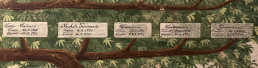
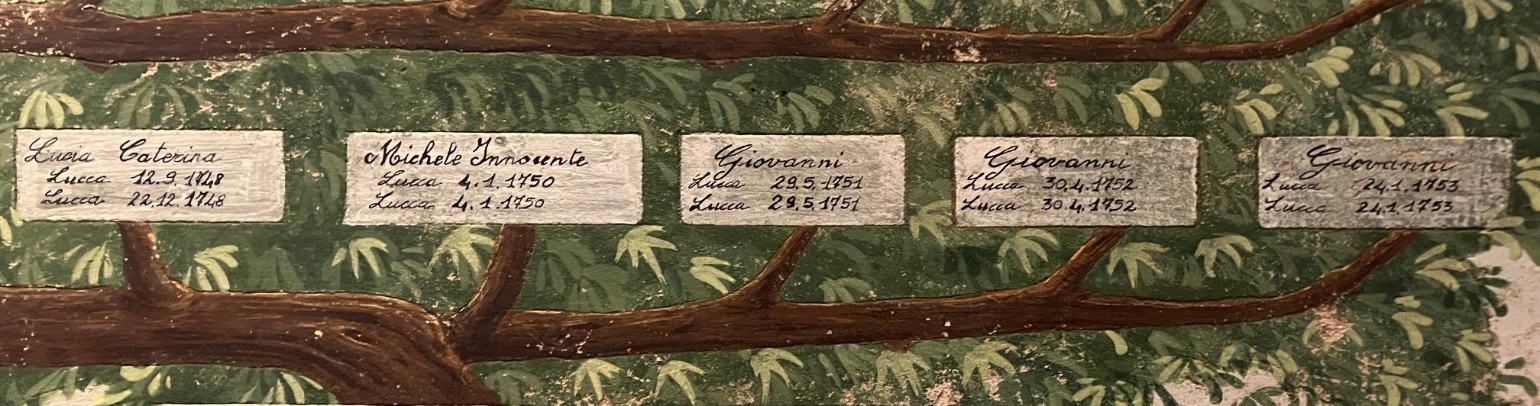
If I sing of love, what of death? For that I bring you back to Casa Puccini in Lucca. We greatly enjoyed our un-guided tour through the apartment where Giacomo was born, raised, lived and worked in his early years. The family had lived in this same apartment for many generations and produced four other well-known composers over five of those generations. Along the way, someone painted this family tree of which I show only one of many branches. If you are reading this on a computer, then you can enlarge the page to read the names and dates if you like. These are the offspring of Giacomo’s great-grandparents. We are all aware of the high rate of infant mortality in the pas,t but seeing it here in green and black and white made it very real. These are just five of Angela Puccini’s eight children. Lucia was born in 1748 when Angela was 26 and she lived three months; two years later Angela had Michele Innocente, who did not live one day; followed by three Giovannis, each about one year apart, not one of whom lived one day. The left side of this tree tells a similar story about her first two infants. Only the third baby survived childhood and went on to continue the family lineage.
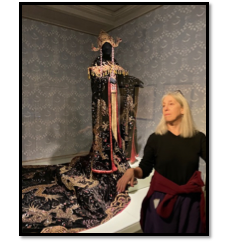
While we are on the subject of lineage, I bring you one more image from the Casa Puccini, this dress worn by soprano Maria Jertiza in the first performance of Turandot at the Metropolitan Opera in 1926. The costume and production were designed by Umberto Brunelleschi. Yes, the great-great-great-great-great-great-great-great-great-great-great-great-great grandson of that Brunelleschi. Here is a picture of the costume in all its glory, taken, remarkably, next to a modern-day opera composer who I found walking around the museum.
Did you know that Madama Butterfly was a flop when it opened in 1904? It was. Reviewers didn’t like it at all. It did not take off until later after he had revised some scenes. So please, all you artists out there who are feeling discouraged that the world is not ready for your work, ignore those critics. The world will be ready for your work soon.
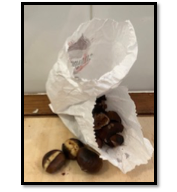
We had been told by some correspondents to these letters to look for roasted-chestnut sellers on the streets of Florence in November and last night, on an outing, Susan finally encountered one. It has been a warm fall but the weather has finally turned chilly so they are beginning to appear, and with them comes an amazing innovation! Two paper bags glued together. One is for the fresh, hot, chestnuts, the other is for their shells so people do not drop them on the sidewalk. It is simple and ingenious and cleanly. This is, in fact, the cleanest city we have ever visited. Have I mentioned that the streetsweeper comes up Via Ricasole every single night at midnight, sometimes twice, but always at the same time? By day, one often sees municipal employees deploying brooms and trash does not linger on the sidewalk. It is kind of surprising and very welcome. Unlike New York City, there is no sign of the animals that transmitted devastating disease here so regularly five, six and seven hundred years ago.
I wish to thank you all for your enthusiasm. It is what kept these letters going. This is my sign-off as we head back to that self-same city in two days.
Arrivederci,
Warren Ashworth
[1] It was occupied by Italy’s King Victor Emmanuel III at the time, and he often had lavish parties with entertainment.

Lettera undici
Looking up.
Naturally, the longer one resides somewhere, the more one wants to understand its history, and not just the history of five hundred years ago, so it is with interest that I have been reading a book published in 1947. By the way, the Italian word for history is storia. “Historical” is storico. Our English words for this derive directly from the Latin, historia and historical. But, like Eliza Dolittle, Italian doesn’t care for ‘H’s. Thus storia. Which is so close to “story” in English. And, add to that, the Italian word for “story” is also storia. So herewith, a little storia.
Monte Cassino is the one battle of the Italian campaign I remember my father speaking about. Like most of our fathers who were veterans, they were able to share their stories with other veterans, but rarely did they share much about them with family and other friends. Edward Kander, my late father-in-law, and Jason Kander his grandson, are perfect examples of that. Ed and Jason were able to communicate in ways that were very particular to their experience. An experience that those of us who have not been to war cannot fathom. On the heels of the extraordinary Christ Stopped at Eboli that I mentioned in Lettera Nove, which ends just before the Second World War, I have been reading War at Val d’Orcia; a Diary by Iris Origo. Ever since arriving here we have been seeing, as one does, many war memorials on plaques and statues, for both the world wars. But we kept wondering what Italy’s involvement was in these wars. My memory was fuzzy on this. We looked it up and were reminded that in both wars Italy started out on the side of the Axis powers but at the end of each conflict had switched to the side of the Allies.
That seemed mighty odd. The Origo book was recommended to me by someone to whom I expressed my confusion. The diary covers the years of Italy’s transition from one side to the other, 1943 and 1944. The book was published in 1947 and is still available. I am not saying rush out and get a copy, but merely that – for me – it is shining a very clear light on what turned out to be a disastrous transition. Very, very briefly, in the summer of 1943, the King of Italy and his circle had had enough of Mussolini’s dreadful excesses and arrested him and ousted his government with the intention of making a pact with the Allies at the same time. However, the Italians dragged their heels on this armistice for three months, allowing the German forces plenty of time, in the fall of ’43, to entrench themselves all over the Italian peninsula with absolutely no resistance as the Italian army had no orders to act. The Germans even un-arrested Mussolini and re-established Italian Fascists into a shadow government.
Little by little, in January of 1944 the Allies started to work their way north from Sicily routing the German forces as they went, with major losses on both sides of the conflict and tremendous destruction. In Lettera Due, I showed you a painting from the ceiling of the Uffizi depicting the results of bombs set off by the Germans on their way out of Florence, which did not occur until August of 1944.
Origo writes about many battles. The diary entries rely on in-person reports, BBC radio transmissions, letters from friends, and newspaper accounts. She also had first-hand reporting from the prisoners of war, the Germans and later the partisans that were billeted in her large house and farm in the Tuscan countryside. Among those battles, she often mentions the conflict at Monte Cassino. And the memories begin to filter in of Bill Ashworth mentioning that he was deeply engaged in that same conflict. According to other sources I have now read, it took months and months to establish the Allies in the German occupied monastery at the top of Monte Cassino and their losses were horrific. In the end it was considered, by many, a pyrrhic victory.
And here I am, not far away, eighty years later.
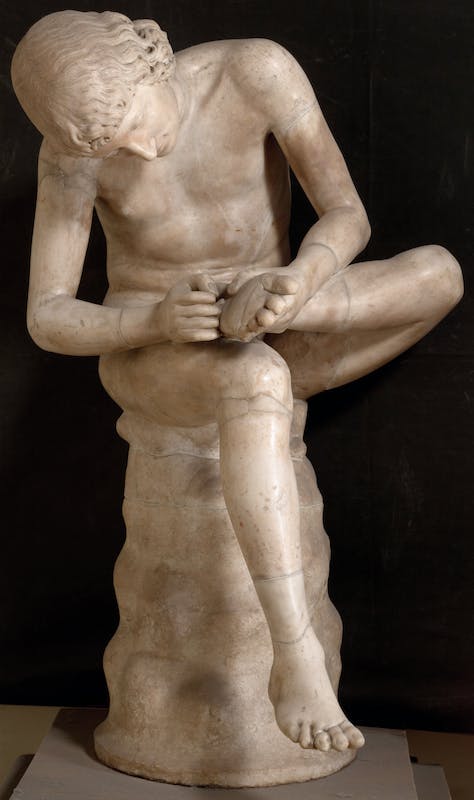
And a more recent storia: before we arrived in Florence certain wives were rather nervous about the overall undertaking but, before we left, she said that the thing most drawing her here, that she most wanted to see again in Florence, was a marble sculpture of the boy taking a thorn out of his foot. She thought she remembered it was to be found at the Accademia and so after seeing Michelangelo’s David, we wandered into the far reaches of the museum but did not find it. Finally, she asked a guard and he said no such sculpture had never been part of their collection. Well, this individual was about two years older than my grandson so his “never” was a pretty short time. We then scoured the Bargello, Florence’s sculpture-centric museum, thinking maybe it had been moved there and though we found this wonderful painting that looks a whole lot like my friend Madeline Nero, we saw no boys taking thorns out of their feet.
I hear all you thirty-somethings saying alright already, just check the internet. So we did. By this time, we have been in Florence for about 7 weeks and certain wives are really pleased with how much they are enjoying being in this town and are even beginning to wonder how it might be if I were invited back next fall. But still, she is determined to find this sculpture that was a high point of her last trip here in 2007. The internet says it has been at the Uffizi since 1857. We have visited three times now and not laid eyes on any thorn-pricked boys. So, we head back late one day when there are very few folks there. We go all around and spend some time looking up. Looking up at the Uffizi is always rewarding, and we unearthed some treasures no one has ever noticed before like this portrait of Gaston Foxius.[1] He is among the hundreds of 17th century portraits of leading men and women, from Suliman to Anne Boleyn, that adorn the upper-most crown-molding of the long corridors known as the Serie Gioviana. Little attention is paid to these, what with the world’s treasures all around and all at eye level. I deeply regret not having made Gaston’s acquaintance before my wife reached menopause as I would have insisted we fire up another boy and name him Gaston Foxius Ashworth. I guarantee you the next novel we write will have a character in it named Gaston Foxius and you, my friends and family, are the first to know.
Still, we hadn’t found Susan’s sculpture. We approach a sympathetic-looking guard and Susan asks him, in very correct Italian, where we might find “Il Spinario” as the internet has informed us the boy taking the thorn out of his foot is called, and it notes that the one in the Uffizi is first century BCE, Roman. “Oh,” he replies, in excellent English, “it is in Boston. It was sent there for an exhibition some months ago”. And so it goes.
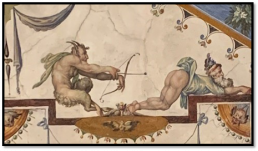
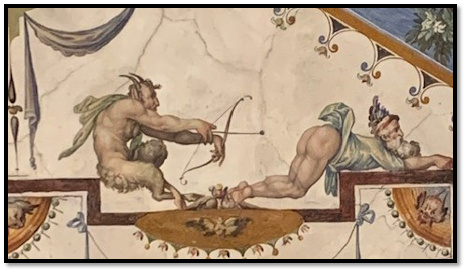
Today, Susan found some amazing discoveries of her own. First, she found a sock store with 100% cotton socks in all kinds of patterns. We now have enough socks that if we were forced to walk across the Russian Steppe we could have a new pair of socks every day and die with clean ones on. Then, she took herself to the Uffizi where, looking up, she found an amazing series of fabulous grotesques (as they are known) on the ceiling of which we send you this gem. These were very much the fashion in the 16th – 17th centuries and every inch of the gallery hall ceilings are covered with them.
She also found this bust of Cicero from the first century BCE. It was dug out of the ground during construction of a Renaissance church. Along with Il Spinario, these were among the Roman and Greek treasures unearthed here that were inspiring the Florentine humanists thirteen and fourteen hundred years later. And they were rediscovering Roman authors, such as this timely tidbit of Cicero’s:
“A nation can survive its fools, and even the ambitious. But it cannot survive treason from within. An enemy at the gates is less formidable, for he is known and carries his banner openly. But the traitor moves amongst those within the gate freely, his sly whispers rustling through all the alleys, heard in the very halls of government itself.” Marcus Tullius Cicero (as recorded by Sallust (c. 40 BCE).
Speaking of authors, we have been waiting to share a little naches until the contract was signed, but now we can tell you that Sam’s book, The Dissection, has been accepted for publication by Santa Fe Writers Project. It will be released in 2025 which may seem like a long time, but Sam is sanguine about it, happy with his editor, and feels that the publisher is committed to doing a first-class job. We did a little danza gioiosa here when the news came in.
And since one can’t have too much Renaissance art, I leave you with this street art from outside one of our favorite pizza places.
Arrivederci,
Warren Ashworth
[1] Duke of Nemours, Captain, killed in action in Ravenna in 1512.




Lettera dieci
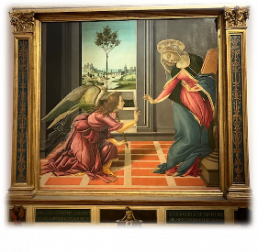
The moon is full again. That means there will only be two more of these letters. When the old moon is in the new moon’s arms, we fly over it to return to New York. Meanwhile there is, in the Uffizi, an amazing annunciation I must bring to your attention.
Setting aside the fact that this, and almost every annunciation after 1100 CE, shows Mary reading, though no such thing is mentioned in the New Testament;
Setting aside the fact that her reading material is a book even though in the year 1 scrolls were what were read, books with bindings not appearing until seven centuries later;
Setting aside the fact that a woman who has been taught to read in either the first century CE or the fifteenth century was a very rare thing;
Setting aside the fact that she is shown with a medieval setting behind her of a style of buildings that did not exist in the first century;
Setting aside the fact that in this and almost every other annunciation except Fra Angelico’s (see Lettera Due,) the Virgin Mary is shown in garments and in a building indicating a very affluent, well-born life of leisure, even though the New Testament indicates she is of a “humble state” (Luke 1:46-55);
Setting aside that, via the agency of an angel, a virgin is being impregnated by a dove (Luke 1:1-4) and that she is unmarried when she becomes pregnant, and that she only gets married later to a nice old guy for convenience and that the painter is participating in perhaps the biggest con of the eon;
Setting all that aside, it is a really dynamic and beautiful painting. It is known as the Cestello Annunciation by Sandro Botticelli. In every other annunciation we have seen (probably 70 or 80 by now,) Mary receives the big news in a passive pose. Here, she limbos to her left, “her body in thrall to the divine message that has been transmitted from Gabriel’s fingertips to her own”. That quote is from author Joseph Luzzi’s new book Botticelli’s Secret: The Lost Drawings and the Rediscovery of the Renaissance. Her “earthy and earthly” sway here is unique, it is vibrant. Luzzi goes on to say “The angel has come to proclaim the coming of God. Botticelli has come to proclaim a different arrival. If ever a historical epoch could be conveyed in a single, simple gesture, here it was: Botticelli’s annunciation of the Renaissance.” Nifty, eh?
Just one detail before we leave Gabriel and Mary. Unlike so many of the works I have mentioned in these letters, this large painting is not a fresco. It is egg tempera on wood, a medium Botticelli really knew his way around. Back in your college days, when your domestic hygiene standards were lower and you had some big paper due, that plate from the fried eggs you left in the sink for three days was really hard to clean, right?. Well, that is the magic of egg tempera. Yolks mixed with pigment and ancillary ingredients make a workable painting medium that is color-fast for centuries (unlike oil paint, which fades and yellows over time). It bonds to a prepared ground and does not want to let go, like your eggs. But it is a very difficult medium to work with. Few painters use it nowadays.[1] One major exception being Andrew Wyeth. Botticelli’s enormous Birth of Venus and his Primavera, across the room from the Cestello Annunciation, were painted in egg tempera.
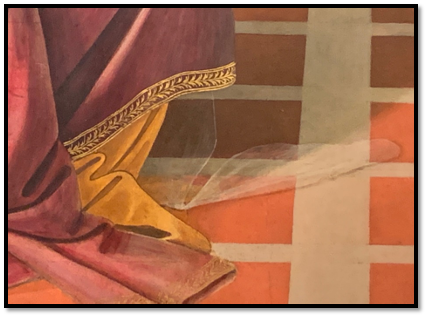
Where I am going with this is to ask you to please just look at that fold of gossamer fabric on the floor in front of Gabriel. Is that not breathtaking? That is Botticelli is saying we know how to do this now and the world will never be the same.
Who doesn’t love Artemesia Gentileschi (1593-1656)? A big-boned gal with lots of mettle. Seventeenth-century heroine, brilliant painter, fighter for justice, rare female inheritor of her father’s trade, exile, teller of truths, and unlike many men, not scared of a little blood. She arrived here in Florence at the age of 23 right after the man who raped her in Rome was convicted of all charges (though he never served his punishment). She was welcomed by Cosimo Medici II, who was continuing the patronage of the arts started by his forebears. He introduced her to all the right people in town including Michelangelo Buonarotti the Younger, nephew of the master. Her time here was immensely fruitful. For his own home, Buonarotti engaged for her to paint an “allegory of inclination”. The fee was the handsome sum of thirty-four florins, the commission, a ceiling panel. It was to be installed in a special room he’d designed to honor his uncle, from whom he had inherited the house. Hers joined the work of other contemporary painters to honor that great, grumpy, jealous, paranoid, impatient man.
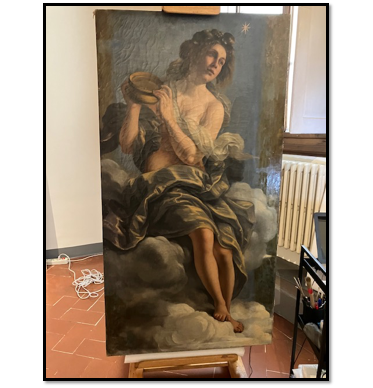
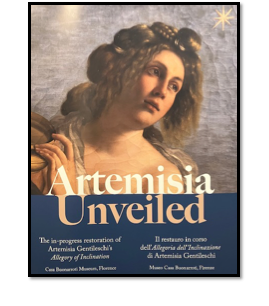
I could not imagine what an allegory of inclination might look like, so Susan and I jumped at the opportunity to view this one up close at the Casa Buonarotti where it has just been taken down off the ceiling. It suffered terribly with age and gravity and was in serious need of rescue. It was painted not with egg tempera but with oil paint, as was common by her time (oil painting was invented in the low countries in the late 1400s and came south to Italy around the middle of the 1500s). In this case, the paint did not bond at all well to the ground and the ceiling panel has been a peeling wreck for years. The exciting thing is that it is being rescued and the rescue is being done in situ at the Casa Buonarotti by renowned restorer Elizabeth Wicks. So, here is our allegorical figure, inclining, and in the process of being reinvigorated.
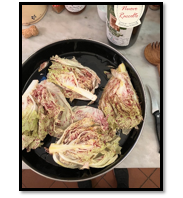
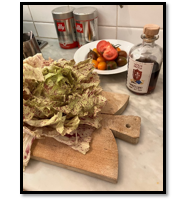
Over and over, I find preparing food here is like I am interrupting someone’s still life. Sometimes, I don’t want to cut up the vegetables because they are so gorgeous. Look at this thing my ortolana offered me. She told me its name but I did not catch it. Was it like lettuce, I asked, in some version of Italian. No, she said, it is more like scarola (escarole) and you have to cook it briefly. Well, I knew how to do that. Anyway, I went ahead and cut it up and it was still beautiful. We had it last night as part of a lovely dinner for eight with the Wilson clan. By the way, that is our bottle of Florentine Amaro there on the counter, next to more tomatoes which are still, saints be praised, in season.[2]
Regarding the indefatigable accordion player mentioned in Lettera Nove, I wanted to say that our friend Tony Piccolo has replied that he is pretty sure Cielito Lindo (Pretty Sky) is the name of the original song our accordionist plays with such regularity. This is cold comfort since I still, regularly, find myself in the kitchen, singing “Ay yi, yi yi”. Oy.
I have just made myself an Amaro Spritz with the above-mentioned native elixir. Herewith the recipe: 2 oz. Amaro; 3 oz. champagne or prosecco; 1 oz. seltzer; 1 orange peel.
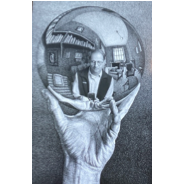
So, my nephew Peter Wilson, his wife Jill and their two excellent daughters, Isaura and Dahlia, aged 13 and 1l, are here visiting. We last saw them at Jacob and Peregrine’s wedding where we told them about our Florence plans. As we understand it, about two weeks later, Isaura had prepared a PowerPoint presentation for her parents, laying out all the reasons the family should come visit us Florence. She had researched places to stay, airfare, museums, things to see and gelato. It worked. They are here for the week. So yesterday I took them over to the Spedale degli Innocenti which I have mentioned here before. Spedale is just short for ospedale – hospital. Inside what had for 500 years been a foundling hospital, is now a museum which has two fascinating special exhibits, only one of which I have the space to tell you about, though it is the one I had very low expectations for – an exhibit of the works of Maurits Cornelis Escher. From the posters around town, I was pretty sure it was some kind of silly come-on for bored tourists but my colleague Cynthia said, “Go”. She was so right. May I recommend taking 11 and 13 year old persons with you whenever you go to an MC Escher exhibition. This exhibition in particular, which is open until the spring. Most of us are familiar with the lovely sensations of getting lost in Escher’s prints, but my great-nieces were not, and they were quite amazed by what they encountered, at one point lying on the floor looking up at an animation of one of his marvelous convoluted staircases. They are indeed great nieces.
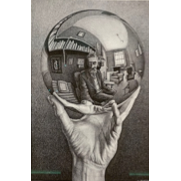
The exhibit has originals of all the well-known prints as well as scores of woodblocks and lithographs I have never seen. But much more than that, the show is wondrously full of interactive moments. Usually I find “interactive moments” in exhibitions, when not broken, something to run from. But these are ingenious. I present just one example here.
The show goes to great lengths to explain the nature of perception in two dimensions and how Escher went about altering that perception.
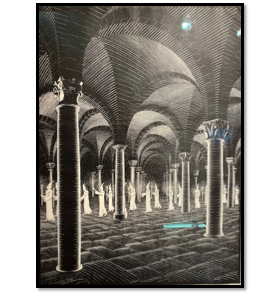
The Dutch-born Mr. Escher notes that his eyes opened and his life changed when he first came to Italy at age 23. Soon thereafter he settled in Rome. It is here he embarked on the puzzles and prints that play with perception. The contrast of light and shadow was quite unlike what he had grown up with and the architecture affected him deeply. There are also many prints in the show that do not attempt to alter perception, they are just beautiful wood cuts, such as Procession Through a Crypt, below.
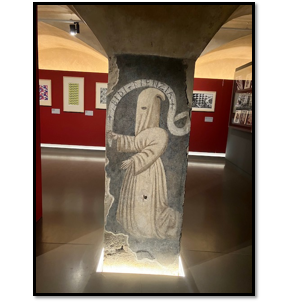
I could go on and on about this show but instead I will just leave you with this. The exhibition is in the crypt of the Spedale. The wood block print you see on the left shows hooded monks moving through a crypt. Well, in the very last room of this show, the columns of the Spedale’s crypt have fifteenth- century frescoes of white-robed monks. Coincidence? I don’t know. But I am sure the curator of the exhibit was pretty thrilled about the serendipity.
I apologize. I find that I have given you the wrong recipe for the Amaro Spritz. It should be: 4 oz. Amaro; 6 oz. champagne or prosecco; 2 oz. seltzer; 1 orange peel.
Arrivederci,
Warren Ashworth
[1] This method of painting was not invented in the Renaissance. The Fayum portraits found on the lids of ancient Egyptian sarcophagi were painted in egg tempera which explains why gazing at them we can feel like they were painted yesterday.
[2] Did you notice that bottle of olive oil in the still life? It has a tag on it that says, “Nuovo Raccolto”. I left it there for you to see. That label means it was just pressed. I never knew there was such a thing as new olive oil. Do they sell it at Fairway? I have never seen it. I have never heard anyone talk about it before this season in Florence. I bought it in my shop that refills my wine bottles (Vino Divino on Via Taddea, fyi). “Oh yes”, the charming young proprietor said, (in the English he told me he learned from watching American television and movies), “it is excellent this year.” Since then, I have heard two other local folks talk about the nuova raccolto. It is excellent this year. This is the kind of new information that makes me feel that Sarah Huckabee Sanders becoming governor of Arkansas maybe just does not matter that much.


Lettera nove
I am writing this with earplugs in my ears. Those nice cylindrical foam ones. Very effective. Not far outside our window, on most days, there is a rather ancient accordion player busking. He is quite capable. I have no doubt that in his youth he played for dance bands and rollicking parties. But that was a long time ago. He is something of a fixture on Via Ricasole. And for the last fifteen minutes he has been playing the tune from “Aye, yi, yi yi, I am the Frito Bandito”. Now, I am sure this Frito’s Corn Chips jingle has a proper source but really, whatever, it is a very annoying song. Thus, earplugs. When we pass by this accordionist, we usually drop some change in his hat. Sometimes the money is to encourage him, other times it is so he makes enough money that day to please, please stop.
But for me, he always redeems himself when he plays the theme from Never on Sunday, which is a movie we watched recently here, courtesy of Amazon.it. With Melina Mercouri and written, directed by, and starring Jules Dassin. It was released in 1960 and, through the miracle of the internet, I see that Manos Hadjidakis won an Academy Award for its evocative score. Have you seen the movie lately? It is absolutely unlike anything ever made in Hollywood. It is superb. Do you remember the tune? I am sorry, I didn’t hear you. Oh – wait, my ear plugs – there, that’s better. I will sing it for you. Dah dah dah dah. Dada da da dah. Dada da da dah. Dada da da dah. It’s coming back to you now? Good. Go watch it. Then put on the record.
I so clearly remember that this movie came out shortly after we moved to Larchmont, New York, from sunny, lovely Los Altos, California where we had a grove of orange, lemon and grapefruit trees in the front yard and a lanai in the back. We drove the whole way and arrived in Larchmont at the end of August, 1960. I was not happy about this move. My sisters weren’t too thrilled either. I have polled them this week. Margaret notes that she was bummed to abandon her best friend, known fondly as “little monkey”. Polly remembers arriving smack in the middle of Hurricane Donna which trounced lower New York. I remember that the first thing Lou Ashworth bought were yellow rain slickers for all of us. I was five in 1960 but by then my sisters were already way old and I remember being distinctly irritated when they got to go to the Larchmont Playhouse and see Never on Sunday and I was not allowed to go. So what if I didn’t know what a prostitute was? I could learn, couldn’t I?
There are some other movies we have seen here that are just marvelous: Marriage, Italian Style. Marcello Mastroianni and Sophia Loren. Another movie would never have been conceived in America. A revelation, such an interesting plot and such mesmerizing acting. I had heard of the 1961 Divorce, Italian Style but did not know of this 1964 companion piece. Sophia Loren is at her best and often, brilliantly, looking her worst. We also watched Zorba, the Greek, made the same year. It holds up very well. And it is so oddly close to the book I am reading now by Carlo Levi called Christ Stopped at Eboli (1945) about Levi’s years in exile in southern Italy as an enemy of Mussolini’s state. Both works describe a world so primitive it is very hard to fathom.
Susan and I have been attending weekly life-drawing sessions since we have been here. Afterwards, there is always wine served and one is encouraged to linger and visit and it is a great way to meet people. But it did not occur to me, until I encountered the story of this crucifix, that life drawing is something of a privilege. The fact is, artists such as Michelangelo, Leonardo, Donatello or any of the other mutant ninja turtles, were not at liberty to work from nude models, particularly female models. It was not done. If they wanted to study the human form, they usually had to draw from cadavers and those were very hard to come by. This became apparent to me (it is well-known to real art historians) when I read about this crucifix. It was carved out of lime wood by Michelangelo, at the age of eighteen, as a gift to the prior of Santo Spirito monastery in thanks for being allowed access to fresh, dead bodies from their small hospital. It hangs in the Santo Spirito sacristy today.
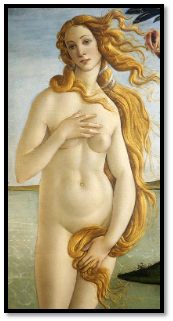
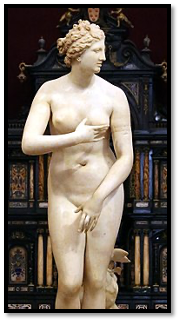
Botticelli had the same constraints. His famous Birth of Venus, here in the Uffizi, was not painted from life but modeled directly from a Roman sculpture to which he appended the head of his muse, Simonetta Vespucci (yes, cousin by marriage of Amerigo for whom America is named, who lived around the corner from us when he wasn’t at sea).[1] This first century BCE sculpture of Venus, left, had been acquired by the Medicis and all the artists mentioned here came to their palazzo courtyard to draw her. No doubt, when their cadavers were getting a bit ripe, they appreciated some outdoor sketching time with stone-cold nudes. It is interesting to me that the creators of so many extraordinary works were bound by this constraint.
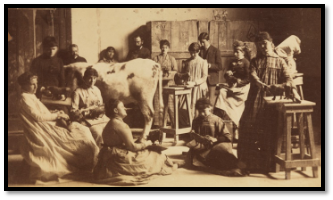
But don’t scoff too quickly, thinking how advanced our civilization is. It might interest you to know that it was not until the late 1880s that the first female art students were allowed to draw from the human figure in American academies. Below is an image of the Pennsylvania Academy of the Fine Arts’ “life modeling” class in Philadelphia in 1882. The women are all students of Thomas Eakins (at the rear), whose work I loathe. They are drawing and sculpting from a cow brought in for the session. The person who broke this pattern, by the way, was a teacher at that Academy named Alice Barber Stephens. It would be another generation until many of the European academies allowed their women to be exposed to the pernicious naked human figure.
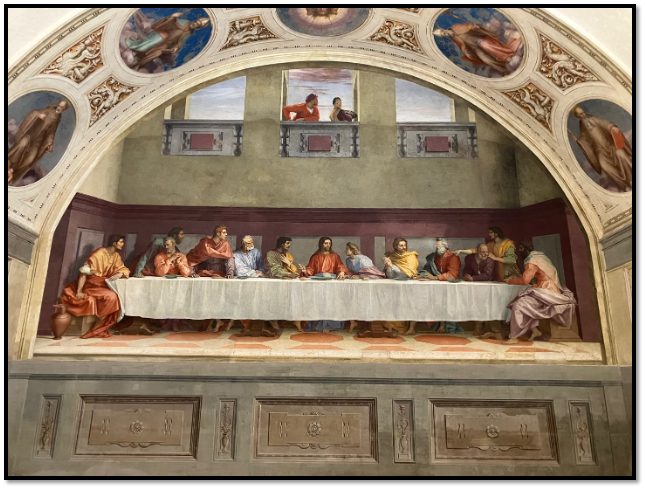
Regarding arty matters, back in Lettera Cinque I mentioned the cenaculo – l’ultima cena, or last supper – fresco, at San Salvi. This former monastery is on the edge of greater Florence, a ten-minute bus ride from our apartment. Susan needed a break from work so we decided to head out there as she had not seen it before. San Salvi had been a monastery and has been converted into a small museum where Andrea del Sarto’s Last Supper is in the former refectory right where it was installed, 500 years ago. It is in excellent condition and looks as if it might have been finished last week. Just as the first time I visited, this small museum was empty except for the nice woman who looks after it. There are a number of other works by people of del Sarto’s circle. Though small and out of the way, this museum is just beautifully lit, clean, clearly and thoughtfully curated in Italian and English, very welcoming, and free. It is typical of a new wave of art and architecture stewardship that is a major testament to the City of Florence. There are signs everywhere that tourist dollars here are being spent on active conservation and broadly revitalized and sensitive exhibitions.
Andrea del Sarto, 1505, Cenaculo in the refectory of San Salvi Monastery in Florence.
After we left the apostles, whose meal – from all the evidence I have seen – was meager, we lucked into perhaps the best Italian restaurant food we have had since coming here (excepting Venice, dove tutti i pranzi e le cene sono sublime). It was just in a little osteria a block from San Salvi, catering to locals. Among all the other delights, their semi-freddo dessert (served with complimentary, homemade limoncello) was supremely delicious. Even the waiter was supremely delicious and we wished we could bring him home.
Leaving aside l’ultima cena, I don’t want this letter to go out without acknowledging l’ultima stagione of Cantata Profana. I suppose almost all of the correspondents who receive this letter are also fans of Cantata Profana, thus you know by now that they have announced that this is their last season and, in fact, November 4 is the season’s first concert. Could it be that the Barbara Strozzi mentioned in the advance program notes is related to the Florentine Strozzi family who built the largest palazzo in central Florence?
Cantata Profana has simply spoiled us all. For myself, when we go to other concerts now, I wonder who was asleep at the wheel coming up with its dull programming, and really, couldn’t they be just a little imaginative with the lighting? Have they any inkling that a published program could be made witty and interesting? We were at just such a concert last week and I was wondering, did it never occur to them that music does not have to be presented in chronological order? Did they not know that there was music before Bach? After Brahms? Well, poor ignoramuses, they never saw a CP show. And we are quite sorry to miss the show tonight though we are enjoying the advance program notes. Do we miss anything else about New York, you ask? Don’t.
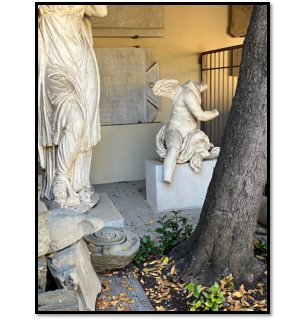
I will end with this delightful image. The other day we were out visiting the church at Santa Croce and wandered around the very gracious back of it where, next to the janitor’s parking spot, we came upon their spare-angel storage area. So useful. You just never know when you might need one.
Arrivederci,
Warren Ashworth
[1] To be clear, there is much debate about this. Simonetta died at age 24, ten years before this painting was done.

Lettera otto
Reflections.
A review of the parts of the brain:
The Frontal Lobe
The Occipital Lobe
The Cerebellum
The Parietal Lobe
The Temporal Lobe
The Venetian Lobe
This last part of the brain, tucked below the pre-frontal cortex, is where we store memories of Venice. If one has not been, the lobe is there, it is just waiting for the vacancy sign to be removed.
We have just come back from four days and nights there, our first together. None of my words or images would be adequate to convey the experience. You have had your own or you haven’t. Those images and memories are stored in your Venetian Lobe because Venice is like no place on earth. It is nothing like Florence, or any other Italian city. I have been sharing Florence with you but Florence, while amazing, is not that different from where you live. It has streets, cars, trucks, bicycles. If you live in a city, then like yours Florence has demented scooter drivers, motor cycles, stop lights, and traffic noise. If you live in the country, you have nature sounds during the day and night. But wherever you live you don’t cross a bridge to get from one side of the street to the other. Where you live your new couch isn’t delivered by boat. Where you live isn’t devoid of sound at night. So silent your ears strain in wonder. Venice is just Venice.
Well, maybe I will share this: when I teach my design history sections on Shaker design, I bring the students this dictum from The United Society of the Believers in Christ’s Second Coming, as the Shakers referred to themselves. A dictum that sums up Venice:
Do not make something unless it is both necessary and useful; but if it is both necessary and useful, do not hesitate to make it beautiful.
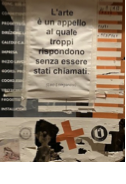
Ok, one picture. Something I doubt you saw when you were there. Late one night (the very best time to be walking around Venice), close to the Peggy Guggenheim Museum, we found this sentiment taped to a door: “L’arte é un appello al quale troppi rispondono senza essere stati chiamati”. I walked right past it but the Italian speaking half of this relationship pulled to a halt. Perhaps this is an expression you know. It was new to us. “Art is a calling to which many respond without having been called.”
That is it. No more Venice pictures.
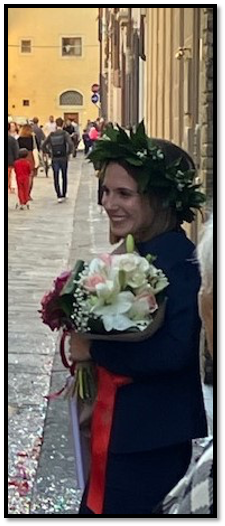
In the interests of continuity, I will note that my mention of the bay laurel wreath on the Donatello David’s head in Lettera Sei elicited some replies. One of my correspondents mentioned that graduate students in parts of Italy were likewise lauded. And, lo and behold, Susan and I encountered this woman, surrounded by family and friends, confetti and flowers, with her bay-laurel laureate’s wreath. She is standing on the steps of one of the universities here. You can see confetti all over the sidewalk and street. She was radiant and it all seemed quite joyous. I took this picture from the hip so as to not intrude. Anyway, I just thought you might enjoy seeing this.
I will also add one more reply from a reader friend regarding Lettera Sette’s Under the Tuscan Buns, noting that her husband was elected as having the “Best bum in the boathouse” at Penn. Thank you all for your input. I enjoy hearing your stories and the memories these letters prompt.
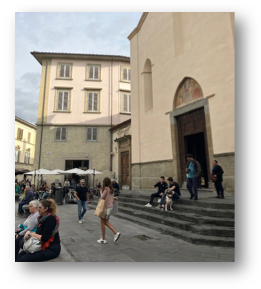
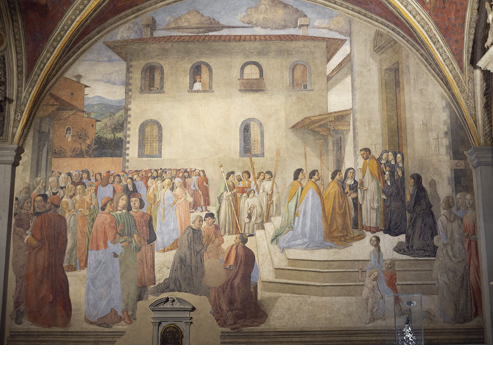
So, last Saturday we went east of us to the Sant’Ambrogio area for the first time. This is where one finds the other, more intimate, mercato in Florence; also, the nineteenth-century synagogue; the modest Chiesa Sant’Ambrogio and in front of it the Piazza Sant’Ambrogio where I enjoyed the best coffee so far. But this is by a very small degree as the coffee everywhere in this land is ambrosia. It turns out to be a delightful neighborhood with very few tourists. Follow along as I would like to show you a fresco from the church that I found fascinating.
It is rare to come upon frescos that represent real scenes, so this is particularly special. Painted in 1486 to honor a nifty miracle that occurred inside Sant’Ambrogio, you get to see a whole streetscape. Look closely at the two images. Not much has changed except the women’s dresses are shorter and the men’s dresses seem to have rather disappeared. The windows are no longer arched in the building behind but it is likely the same building. Pretty cool, eh? I mean the frescoist – Cosimo Rosseli – had to have stood on this spot to do his preliminary sketches. 536 years ago. Well 538. It took him two years to create this busy scene (the painter’s self-portrait is looking out at you from the lower left corner, by the way).
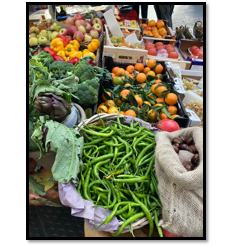
This photograph is from the Sant’Ambrosio market. Maybe more than anything else, after nine weeks in Florence, I am still stunned by the freshness of the produce here, by its abundance, by the care its purveyors lavish on it. I mean, look at this display. This beauty is not accidental.
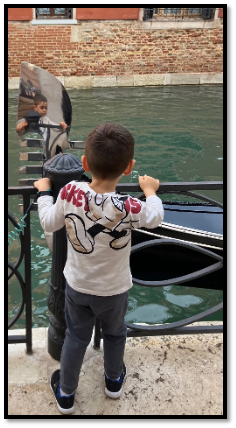
OK, one more Venice photo of a little boy checking out his reflection in the prow of a gondola.
Arrivederci,
Warren
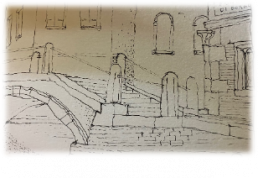
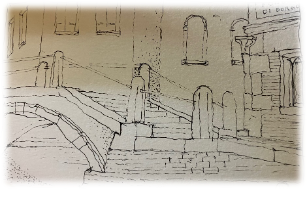
We did have some fine opportunities to just sit and draw in Venice.
Lettera sette
Under the Tuscan buns.
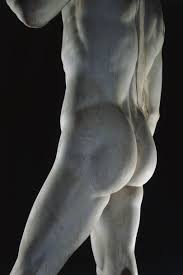
For males of a certain age there are distinct downsides to visiting Florence. For us it is not all happy seraphim-with-lutes and glorious sunsets. It is not all gaiety and late-night, jetlag-induced wine fests. No, here we are faced with cold, hard reality at its most glaring. Because inevitably, your partner is going to insist on going to the Accademia. Your partner is going to want to see it.
If you doubt me, look out my window here.
That dismal river of umbrellas is the line for the Accademia. Every day, right on our street, it snakes around the corner and way down the block. There are an insane number of people from all over the world waiting to get in and all because of one work of art. Yes, there is a side-room full of plaster casts of sculptures (that just re-opened) and there are some Madonnas and a Saint Sebastian by Who Ha but really, there is just one thing these folks are lining up for. They are there because their partner wants to see it.
No, that is not the “it” I am talking about. There is nothing we can do about that “it”. That “it” is God-given, Dieu-donné, dato da dio. Nothing we can change there and your partner accepted that long ago. No, it is the other “it” I am talking about. The one we could do something about if we only tried a little harder. You might be a great provider. You might cook well. Maybe you are gifted with enthusiasm for folding laundry. Maybe you excel at the art of partner massage and continue to do it even after all these years together. Maybe you are really handy and can fix all kinds of household things. Maybe you are a wiz with computers and electronics and have made your home so smart you can lower the blinds and turn on your partner’s bath while still on the B train. Maybe you are just really good at making reservations for restaurants, hotels, spas and resorts and the arrangements to get yourselves there. But gravity and the general avoidance of doing lunges makes all that incidental and irrelevant. Because yours just does not look like this.
At the Accademia, the exhibition of the hero David is arranged so you can comfortably walk all the way around. In fact, you sort of have to, given the crush of people circling him. Can you imagine if there were a microphone on his back, nestled in there alongside the slingshot? How many languages are there on earth? It would pick up the same comment in all of them. The very same comment, “Why doesn’t yours look like that?” From the first 8:15 am ingresso to the last 7:15 pm uscita you could compile a recording of a multi-lingual collective wail from partners who live with this disappointment daily.
Right? I mean. They see it most every morning. But we don’t. Can’t. The mirror won’t go there (unless she or he had your architect install one of those three mirrored door-things that would give a perfect view). So, it is not something we think about. But, brother, come to Florence and you will. It happens that my partner has just bought us timed entry tickets for this weekend. Do I sound worried?
On a more enthusiastic note, this week I went with my colleague Cynthia Mohr, and later with my students, to the Davenzati Museum, which just reopened after a renovation. Yes, I assumed you haven’t heard of it, that’s why I am bringing it up. It is one of the places to go when you come back for a second visit. It is an amazing, five story palazzo built in the trecento (fourteenth century – you may remember that the Italians have the good sense to refer to centuries by their actual number, not one-hundred-years later). Its interior abounds with wall finishes that were painted there 650 years ago and have not been destroyed and it is full of furnishings from the period. It still has its original kitchen and toilets. Yes, the house had indoor toilets on all five floors, some of them ensuite, no less. Even the frescos on the walls of the bathrooms are delightful. This house museum displays a quilt. I hear you yawn. What house museum doesn’t have a quilt? But this is the earliest known quilt. It is called the Guicciardini Quilt and dates back as far as the house’s construction. It is in exquisite condition and tells the story of Tristan and Isolde. Plus, there is a beautifully displayed lace collection here, if you care. Which I absolutely don’t. (said Pierre)
Look at this tapestry from a Davenzati bedroom. Is that not the most endearing lion you have seen since Burt Lahr’s? And I am pretty certain Maurice Sendak was at the Museo Davanzati before us.
It is just one of many delights in this house but pictures of it are pretty much pointless. They just are. Before we leave it, though, I will tell you that it has openings on the piano nobile (the first floor – have always enjoyed the sound of that phrase) that allow the homeowner to pour, boulders, boiling water or oil on attackers who breach their gates. Florence was still a very unstable place in the 1300s. This amazingly intact house attests to a fascinating dichotomy between the potential for major violence from without and a life of serene and sumptuous comfort within.
Ok, yes, perhaps you have been wondering, I did finally go to the Boboli Gardens. I remember so well when we were in Florence with Sam and Jacob in 2007 and we really wanted to get to them but just did not have time. Well, I went this past week with a class I am taking from my host school (called the Santa Reparata International School of Art, or SRISA). The class is called “The Essence of Florence” and the teacher takes us all around town. The garden is just behind, and is entered from, the Pitti Palace. It was amazing how much it reminded me of Versailles – both huge formal gardens laid out behind enormous palaces. I detest Versailles.[1] I find it such a loathsome excess of indulgence it renders itself ugly. Well, now I can say the same for the Pitti Palace and its gardens. Dull, symmetrical, formal, colorless, huge, and never intended for the public. Both gardens speak loudly of man’s desire to subjugate nature. Everything must submit to the will of the blade, that is, everything needs to be trimmed. The grass, the endless low hedges, the high hedges, the allees, even the trees. Both palaces and both gardens were massively expensive. So expensive that one of them helped bring down a monarchy. Of course, today, they are both open to the public (but neither is at all free, it is worth noting.) Maybe you are fond of these places and feel this outburst is unbecoming. Oh well, we can’t agree on everything.
I threw out all my Boboli photos except this stair pavilion, which I found quite attractive.
Ever since I was in knee-pants I have wanted to work with one of these. I saw my first one when I was eight at the Mamaroneck Art Barn where my parents took me for Saturday morning painting classes. This past weekend I finally got to play with one. This is an etching press. It weighs more than a Fiat 500 and once you park it, that’s it. The solid steel roller makes pulling a print a whole new experience. This beauty is in the print workshop at SRISA. The head of the school, Rebecca Olsen, who is also a printmaker by trade, ran a workshop last week for those interested in learning more about making monoprints. She invited me to join and, well, who doesn’t want to know about making monoprints? The process is defined as a single print taken from drawing on a solid surface – glass, plastic, copper – and then inking it in a particular way followed by pressing paper onto the surface and pulling a print. Such a simple explanation for the universe of possibilities monoprinting presents. Suffice it to say, both these prints came from the same plate. The fun of it is that amazing accidents happen. The bummer is you’ll never get them to happen twice.
The inspiration for the print comes from this quick sketch I did under the gracious loggia of Brunneleschi’s Spedale degli Innocenti, around the corner from our apartment. Which is like saying, “Oh yes, as it happens, that is a Matisse in my bathroom”. Makes you want to slap someone. Save it ‘til you see me.
Here is a photo of our incredibly hard-working composer. Today she finished the score for Carry My Own Suitcase. It was momentous. We went out to the Grand Café San Marco and had cannolis, babas-aux-rhum, and Sacher torte. I am very proud of her. She is my hero. Not that the work is done. She still has orchestrating to do. But, this step is huge. We are going to celebrate more this afternoon by shopping at the Merceria for new socks.
Now, speaking of heroes, Susan and I saw something last night on our way to a performance of Handel’s opera Alcina that reminded us of our hero of We, the House, Ambleside. We saw a murmuration of starlings. There is a chapter in the book called Murmuration in which Ambleside witnesses this spectacular phenomenon (Chapter 24, page 123, fyi). Neither he nor his interlocutor know what the phenomenon is called, but he is transfixed by it. Now you might argue a talking house is already transfixed and cannot be untransfixed and you would win that argument and I would buy you a beer. After you slap me. Well, anyway, there we were, walking around the back of Santa Maria Novella and the starlings appeared (how apt that it should happen above the very church dedicated to the short novel ). I enclose a photo here but am attaching a video to the email. I do hope you will be able to open and watch it. I have only seen this a few times before. It still amazes. How do they all know to turn at the same instant?
One last hero to mention. Cecilia Bartoli. She is the soprano who sang the role of the witch, Alcina. You may not like Handel’s baroque work. You may not like opera. You may think sopranos were invented to increase sales of ear plugs. But if you do not know of this singular musician, stop rolling your eyes and go to Spotify or Pandora (or Lloyd, to your record collection) right now and put this in the search: Cecilia Bartoli, Le Nozze di Figaro/Act 2/ Voi che sapete. You who know, know that Ms. Bartoli is an international living treasure. It was a huge privilege to see and hear her and the performance was one of the greatest we’ll ever hear.
OK, I better stop here. I don’t want to stretch your tether. Though I will say, it is only Wednesday…
-Warren Ashworth
[1] This is not to denigrate the upcoming Opera Lafayette concert “In the Salons of Versailles” being performed at the Kennedy Center on December 2nd under the musical direction of Jacob Ashworth.
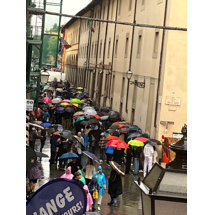
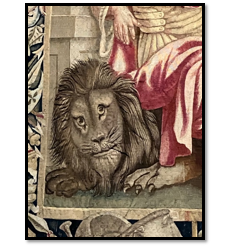


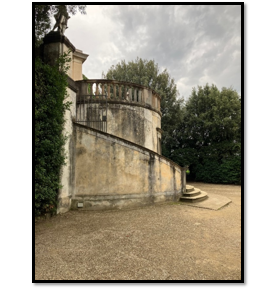
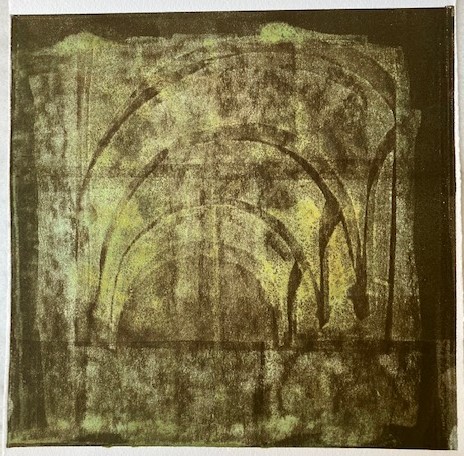

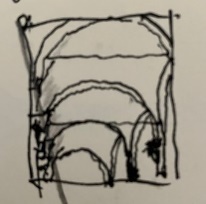

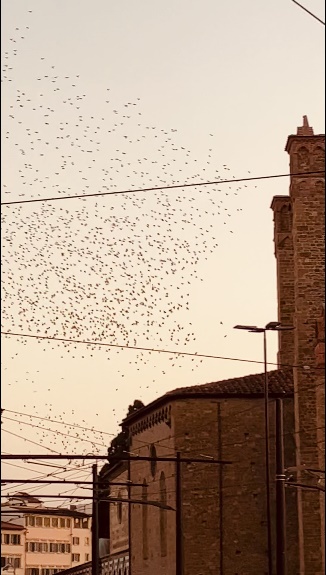
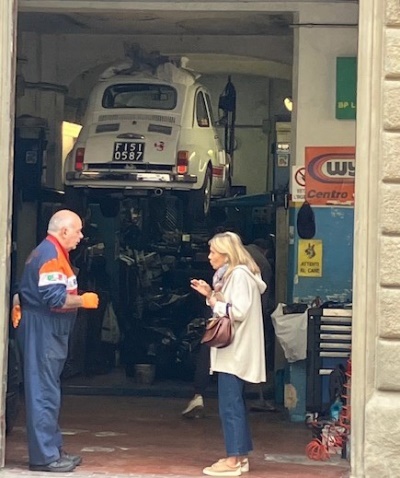

Lettera sei
Porchetta.
This shopping-at-the-Mercato thing looks easy, right? You point, they weigh, you pay, they say, “Grazie”. But, in a language one only knows ten words of, it is harder than that. So, I thought I would let you know that today I reached a milestone with my ortolana.
The first two times one goes to the same vendor, they assume you are another tourist, they are perfectly polite, but the purchase brings satisfaction to neither party.
The third time there is a hint of recognition but my Italian is as rudimentary as the first time. It’s no coincidence that “rude” and “rudimentary” are cognates. It is rude to engage in a transaction with no language except uno, due, tre, quattro, cinque which I learned in Mr. Johnson’s seventh-grade social studies class. So, I have been trying to retain words. Words for weights: un etto, due etti; for sizes: grande, piccolo; for less and more and enough – basta – which everybody knows. Words for colors, sizes. Then the words for the products themselves, some of which we all know, like mozzarella. (If you come to Italy be sure not to buy mozzarella. Because, if you do, and then you eat it, you will never again be able to have mozzarella back in the United States where white rubber seems to be one of its ingredients.)
On the fourth return visit the greeting is more cordial. And I begin to know the names of things. Cachi (persimmon) is a nice new word. I got quattro of those today. I always stumble over the word for apple which is mela but comes out as malo which means bad (for this I blame Jacob’s heart-wrenching solo at age eleven. This was in New York City Opera’s production of Benjamin Britten’s The Turn of the Screw where he played the doomed boy, Miles, with Tony Piccolo as chorus master. The song was called Malo. It is all about bad people and apples).
A brief description of my ortolana, my vegetable seller: she is about 5’-1” tall. To reach the pomodori neri from their upper perch she climbs up two boxes. (Here in Florence, probably all of Italy, the customer never touches the produce unless they are specifically invited to and then only with a plastic bag on one’s hand for protection.) She is younger than I by fifteen years, very professional and quite proud of her produce. On my second visit I made the gaffe of buying zucchini, which she also sells, from the vegetable man across from her. I received from her a hard look. She speaks no English which may simply be a choice to keep at bay the English-speaking tourists who swarm the Mercato. She usually wears a dress, warm stockings, and a big apron with lots of pockets.
Today’s milestone visit to l’ortolana was my tenth, I think. Not only was I greeted with a lovely smile but I was given a bunch of fresh bay leaves and – a touch on my shoulder, which is a good deal higher than hers. It was a small moment of satisfaction on the part of both parties.
And then there is the porchetta. So, I lived on this earth for 66 years before I ever tasted porchetta. That is a very long time. There were 66 years between the first flight at Kitty Hawk and the first moon landing, just by way of example. I first had porchetta at Jacob and Peregrine’s wedding. To describe it – I can’t – I am running out of superlatives. You are going to stop believing me because of their overuse. I will just say it was very good. Now, today I went to my other favorite stall at the Mercato to buy our olives, cheese, and Tuscan salami. The woman behind the counter, perhaps because this is my sixth time there, gave me a little taste of everything before she prepared my orders. Just as I was about to say basta, I saw she had a lovely, fat roll of porchetta and I indicated that I needed some slices of that. So, she gave me a taste. As I took it in my mouth, I felt like I was having a religious experience. I nearly wept it was so delicious. I told her it was squisito. Which, as a review, was inadequate. I really wanted to tell her that I had first experienced porchetta at my son’s wedding which was just this past summer and that I had never had it before and that I felt like I had been missing it all my life and that the wedding was just this sublime three-and-a-half day sumptuary of joy and love with music and food and humor and tennis and that her porchetta was making my knees weak. But I didn’t tell her any of that because I don’t know the word for knees in Italian.
While we are on the subject of food, I just wanted to say that last week’s artichokes were delicious -though they were not delicioso. Susan’s amazing Italian teacher, Marco Pelle, says that one avoids using delicioso when discussing things done in the kitchen. He advises the adjective is reserved for things done in the bedroom. Good to know. Thank you, Marco.
I mentioned bay leaves. I don’t want you to think we have just been eating, neglecting art all week. We did indeed get to see the most exquisite bay leaves in Florence with our friends Deborah and Ian. They are here for their first visit ever. Susan and I have held off going to the Bargello so we could see this divine sculpture museum with fresh eyes, side-by-side with friends. The Ashworth- Kanders were last in Florence with Sam and Jacob in 2007. We visited these famous bay leaves then, but 2007 was a long time ago. Rest assured they are still there. (Yes, they are indeed bay leaves. That’s what laudatory laurels are made of -bay laurel – and it is why Linnaeus named the plant Laurus Nobilis). There they are, on top of his magnificent head, wound around his helmet which I always felt looks much more like a straw hat than a helmet. A straw hat that he put on for a Sunday stroll. A naked Sunday stroll. Naked, save for his hot, hot, calf-tight boots, his sling shot and, of course, his terrible swift sword.
The truth goes marching on.
Warren Ashworth