Irony: “From the Greek eironeia – an incongruity between what might be expected and what actually occurs”.[1]
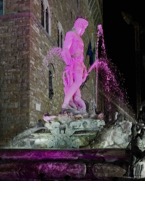
Yes, it turns out that October is also Breast Cancer Awareness month in Florence. Among other venues, it is being celebrated at Neptune’s Fountain in the piazza della Signoria in front of the Palazzo Vecchio.[2] Here Neptune is surrounded by satyrs, each of whom is a comfort to him as he celebrates this special month.
And, yes, we are back in Florence, arriving just in time for the last day of Breast Cancer Awareness month. Our oncologist, who was herself born in Bologna, felt that nothing could be more recuperative than five weeks in Florence.
I am not denigrating the importance of this month of awareness. Far from it. Susan and I are both quite aware that, despite her lifelong antipathy to the color pink, the medical knowledge, the level of care, and the positive experiences we have encountered within today’s breast cancer universe owe much to the initiatives that Susan G. Komen’s sister started all those decades ago. I merely find it amusing to see Neptune all in pink.
It is remarkable being back in a place we felt we knew well. There are still many streets we have not walked down, and many things to see for the first time on the streets we thought we knew. The first day is brutish, of course. One simply tries to keep one’s eyes open, walk a lot to avoid having a nap and to get acclimated to the time zone.
On that first day, after getting acquainted with our pleasant apartment on the Via XXVII Aprile, we went to a local grocery to lay in basic supplies for breakfast.[3] We had a dinner with a friend here, a colleague of mine at the local host school. Someone we like very much. She invited us to the very same restaurant that she brought us to a year ago, for what was then our very first dinner. I am sure the Germans have a word for doing the same thing in just the same place at just the same time, a year apart. Feel free to send me that word.
The night was restful thanks to various prescription drugs and we woke up with the sun, feeling rested. If you don’t have good drugs you will lose valuable time here. Make sure your doctor is indulgent in this regard and if they are not, consider finding one who is. Brevi ferarum; sunt multi doctores – Vacations are short, doctors abound.
In the morning we went to the café downstairs and had our first frothy cups of cappuccino. Looking back at my previous twelve letters I find that I have barely mentioned the coffee here. An omission. The coffee in Italy is ambrosia. Remembering your first kiss is something we can look back on and that reflection is a lovely thing (well I hope it is a lovely thing for you). The beauty of coming back to Italy after any length of time is that the morning cappuccino you drink is just like the first one you had when you first fell in love with Italy. And if you haven’t been here yet, you can just tell yourself I am exaggerating. But I will offer you this: if your first kiss really wasn’t that good, or if it was really yucky and gag-me-with-a-spoon bad, then just come here, stand at the counter of a café and all that will be put behind you with your first sip.
We wandered over to a merceria, (housewares store), and picked up a few things the apartment lacks plus some pantofoles (slippers) for Susan. I have been to this particular store often and while not customary for mercerias, this one stocks dried legumes and flours in big burlap sacks. In keeping with the note that one sees new things while walking down familiar streets, I was excited to discover cecchi nero – black garbanzo beans – for the first time. I can’t wait to soak them and see what becomes of them.
Before we left New York I found my old copy of The Agony and the Ecstasy, Irving Stone’s 1961 book about Michaelangelo. I read it about twenty-five years ago. I find I remember so little of it, it is a pleasure to read again. Michaelangelo was raised in Florence and the book is an excellent digest of his early years here. At fourteen he is invited by Lorenzo di Medici to join a school for sculptors led by Bartoldo, a sculptor who was Donatello’s assistant. Their work yard and shop were in a Medici garden across the street from San Marco (two blocks from our apartment). Before long, Lorenzo, recognizing the teenager’s genius, invites him to move into the Medici Palace, known now as the Palazzo Medici Riccardi, and become an extended member of the family. Stone describes a very close relationship with Il Magnifico himself. The year is 1488 and Savonarola is worming his way into the social and cultural life of Florence where, in a few short years he will be the head of the “new” republic.
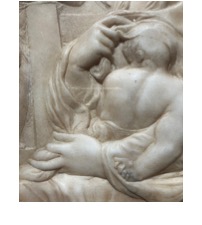
The first three sculpted works of the young Michealangelo are still here in town, two at the dowdy museum called the Casa Buonarroti which I mentioned briefly in Lettera Dieci. The Madonna of the Stairs, as she is known, is his first completed work in marble. He was fifteen. It is the first ever image of the Christ child with his back fully to the viewer and it is the first to put the Madonna in a quotidian setting with his BFF John the Baptist playing around on the stoop. Stone’s book makes clear that the artist was thinking independently even in his earliest years.
The third sculpture we know of is at Santo Spirito, a wooden crucifix shown in Lettera Nove, made when he was 17 as a gesture of thanks to the Prior there who allowed the sculptor to do dissections of the indigent dead deep at night, in secret. If he had been caught, Michaelangelo would have been executed and the prior excommunicated. The book is just a magnificent, scholarly, and fascinating novelization of his early years here before going to Rome, where he spent most of his life. If it is gathering dust on your bookshelf and you are considering putting Florence on your itinery, don’t leave home without it. Our great fortune is that we can now go back to these two places and visit the work again, knowing a little more than we did before.
I know you are wondering, so yes, we have been to see my ortolana, Rita, at her stall in the Mercato. No, I did not take any pictures of her. That would not suit at all. She was pleased, perhaps, to see me and surprised a year had passed already. To Susan’s delight, both green and purple figs are still in season. We also bought artichokes on long stems, clementines, greens, the local green and red radicchio, stunning tomatoes, and herbs. When everything was tallied she gave us a pomegranate “per buona fortuna”. We then moved on to the lateria I favor, where the lovely female half of the couple who run it has always welcomed me with a lovely smile, and bought three kinds of salami, plenty of porchetta, mozzarella, and hunk of three-year-old parmesan cheese.
Perhaps we have the pomegranate to thank for what happened the next night, the night of Ognisanti – All Saints. November 1st. All the churches (and cemeteries) open on this national holiday, giving us the opportunity to visit the church at San Marco, so close by. I have described the museum at San Marco before, where Fra Angelico’s magnificent Annunciation is to be found and where one may visit the cells occupied by the evil Savonarola until his gruesome demise. Last year the church itself was not open due to construction in the piazza so we were delighted to be able to go in. It is a fairly simple, hypostyle church without side chapels and with very little ornamentation as befits the Dominican Order of monks who inhabited San Marco Monastery for five-and-a-half centuries.[4] There were about ten people there and organ music was playing. But, instead of the canned atmospherics you often hear in churches, it quickly became apparent that someone was playing, really playing. The organist, tucked behind fat columns at the side of the altar space, was clearly improvising, playing from the heart. It was stunning to hear the flow of what Susan describes as “uncomplicated, broad, gently emotional sound landscapes” in this large but comparatively simple space instead of the usual highly decorated, stylized, thumping or four-square exhortational stuff. We sat in the old hard pews in different parts of the church. We listened and I sketched. The man played on for over ten minutes, volume and density rising and falling, major and minor, questioning and answering, doubting and glorying, but simple simple; and then, with a final long, grand sonority of closure, the space was silent. The organist stood up, put on his jacket, picked up his satchel, and headed out into the wide nave of the church toward the front door. Susan intercepted him to thank him, and I saw her chat briefly with him. She told him how beautiful and personal his improvising was – “Yes, that is just my own music,” he confirmed, quite bashfully. She told him that it was her mother’s birthday, her mother che è morta, and grazie tanto, suona bellissimo. The next thing I saw from across the nave was that, instead of continuing toward the door of the church, the man turned around, walked calmly back up onto the altar, took off his jacket and put his satchel back down, whereupon we and the three people left in the church were treated to another fifteen minutes of exquisitely humanistic music.
I should explain that my wife generally detests organ music. She says this is the first time she has ever heard the instrument played in a church setting that seemed to put Religion completely aside (aided because the cross suspended over the altar was only a representation without a corpse dripping blood). Instead, it was simply one person speaking from the heart in his own deeply personal language to and for all. A full meal.
After that sublime and, for Susan, deeply emotional experience, we walked over to the Piazza SS. Annunziata, where is to be found the Ospedale degli Innocenti, as I have described before. This perfect night the piazza was ever so quiet and the sky was a blue-like blue, so blue as to redefine blue. We walked up to the Caffè dei Verone on the top floor of the Ospedale for an aperitif. In my very first letter I wrote about this incredible café in the old laundry loggia on the top floor of the orphanage designed by Maestro Brunelleschi. Not only was the man brilliant with his never-before-seen façade, but his back-of-the-building, quotidian, open-air laundry-drying area is a work of art. Anyway, the orphans and their sheets and gowns and diapers are all gone but this is still the view.
So, yes, we have been here before. Part of the joy of learning a city well is returning to the places that brought you joy. And it is why we are sometimes less keen on setting off for places unknown.
To that end, we were very lucky to be invited by Professoressa Cynthia Mohr, the friend mentioned above, to a gathering of her women’s circle to hear a talk by one of its members, Elizabeth Wicks. In Lettera Dieci I explained that Ms. Wicks is an American art conservator of the first water. A year ago, we went to see her beginning the restoration of a grievously dilapidated Artemesia Gentileschi painting that has spent its last 408 years at the aforementioned Casa Buonarotti bolted into a ceiling panel for which it was commissioned by Michelangelo the Younger, the Maestro’s great nephew. Italy – to its credit – has made it a policy that the process of restoration of great works should be, when possible, viewable by the public as opposed to happening behind the scenes. I provide herewith the before (in process from a year ago) and the after (which we saw yesterday).
Ms. Wicks spent a couple of hours talking about what was involved in this restoration as well as speaking about the life of the astonishing Ms. Gentileschi. The finished restoration of the panel, known as The Allegory of Inclination, is the centerpiece of a brand-new exhibition at the Casa Buonarotti. Part of the exhibition includes another astonishing work by the artist on loan from the Palatine Gallery in the Pitti Palace (where we were on Thursday) done a year after this called The Penitent Magdalene. If you are not familiar with the life story of this painter then you need to be. I am sorry to be demanding but that is just a fact. To understand her Judith and Holofernes, her Magdalenes, her Susanna and the Elders, her Allegory of Inclination, you need to know a bit about what this individual went through in her life.
Why?, you ask. Do I have to know about the lives of Henri Matisse, Édouard Manet, or Kieth Haring in order to enjoy their work?
No, I reply.
Well, is this some feminist claptrap you are insisting on? Just because she is a woman painter, I have to know about her?
No, I reply. Henri Rousseau. Jean-Michel Basquiat. Edvard Munch. Those are men who you need to know something about to best appreciate their work. Likewise Artemesia. No whining. Go look her up.
She was 17 when she painted her Susanna and the Elders which is a masterpiece. She was 21 when she moved to Florence from Rome and painted this Allegory of Inclination. She painted The Penitent Magdalene a year later. Wicks confirmed that the women’s faces in most of Gentileschi’s paintings are reflections of her own facial features if not outright self-portraits.
So now she has a special exhibition all her own showing work from her earliest years, an exhibition mounted in a house that celebrates the early work of another gifted artist who also started very young. While there I took a detailed photograph of Michelangelo’s bas relief Madonna della Scala to share with you. I invite you to compare the brilliant representation of hands in both works. Even the hand of the child in Mary’s lap is exquisitely carved.
One artist has been well known and admired for centuries. The other, finally, in the last generation, is taking her richly-deserved place in the pantheon. How fitting that the latter is being celebrated in the casa of the former. How exceptional to be with them together.
Warren Ashworth – Florence
(One note: I make reference to past letters. These may now be found at www.WarrenAshworth.com/Letters)
[1] Quotation from We, the House by Ashworth and Kander, page 1.
[2] Designed by Baccio Bardinelli and completed in 1574, commissioned by Cosimo 1 de’ Medici in 1569.
[3] I do not yet know what happened on the 27th of April that it is celebrated with a street name, but I will find out and be sure to let you know.
[4] Hypostyle simply means the ceiling is flat, not vaulted or peaked. There were Dominican friars using the monastery all the way until 2014, in the western part of the building not designated for the museum.