Reaching For It.
We are seated at the Café Brunellescho in the shadow of the Ospedale degli Innocenti and a few footfalls from where Susan is enrolled in painting classes. The food at this trattoria intima is some of the best we have found here but more importantly, the people who run it are lovely. We are sitting outside, eating a really delicious meal and taking in the waning autumn sunlight. A rotund Roma woman is making the rounds of the tables, asking for spare change. When she gets to us we decline and continue with our lunch. I do not care to be importuned while dining. After some minutes she comes back around and asks us for the bread that accompanies all meals here – tasteless, saltless, difficult bread that is a Florentine staple. This pane Fiorentino always carries a subtle message that says yes, we know tourists come here by the millions every day but we are not going to change a 500 year tradition of saltless bread just to make you feel good. This is the bread of affliction, tourists: suck it up.
Anyway, the Roma woman appears to have no such grievances about the bread and asks us for some. I gladly give her ours and she moves away. I continue enjoying my spezzatino di manzo, chunks of tender braised beef. But before I know it she is back, mumbling in her own language, and we watch as – almost in slow motion, zoomed in – her weathered hand reaches across our little round cafe table and she grasps in between thumb and forefinger the largest, juiciest of my pieces of beef. Delicately withdrawing it and placing it in a napkin, she trundles calmly off into Via degli Alfani. Ah well. I imagine she found it as delicious as I did.
I enclose herewith another lovely example of Reaching For It. This one is from a painting by Neri di Bicci from 1472. Susan found this in the tiny museum directly across the street from our apartment, the Cenaculo Sant’ Appolonia, which houses a sublime last supper. These cenaculi, huge frescoed murals of the last supper (il ultima cena), were the traditional adornment that graced the wall above the head table in refectories throughout Florence and other cities. The most famous one, of course, is in Milan, by Leonardo Da Vinci.[1] There are 37 still extant in Florence and many more are long gone. This gives you some idea of how many monasteries this city hosted, each one with 50 to 100 monks or nuns. If you consider that by 1347, with the monastic movement surging, the population here was about 110,000, you get some sense of their presence.[2]
I touched on this particular Cenaculo in a previous letter. But I was always so occupied by the delights of the fresco that I failed to pay much attention to the four ancillary paintings in the vestibule of the museum, until Susan brought this painting to my attention, featuring a clearly age-old gesture.
One thing it turns out you should not reach for is something mentioned in my Lettera Tredici. It turns out there is a reason you have probably never encountered black chickpeas. After soaking them properly for a day and cooking them gently, without salt (which you should never use in cooking chickpeas as it retards the softening process), for the requisite time, I found they tasted like little balls of construction paper. Black construction paper.
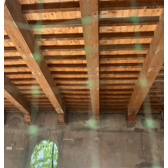
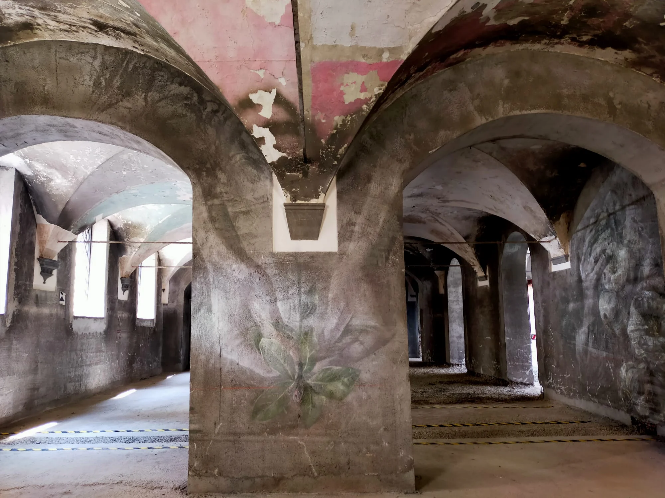
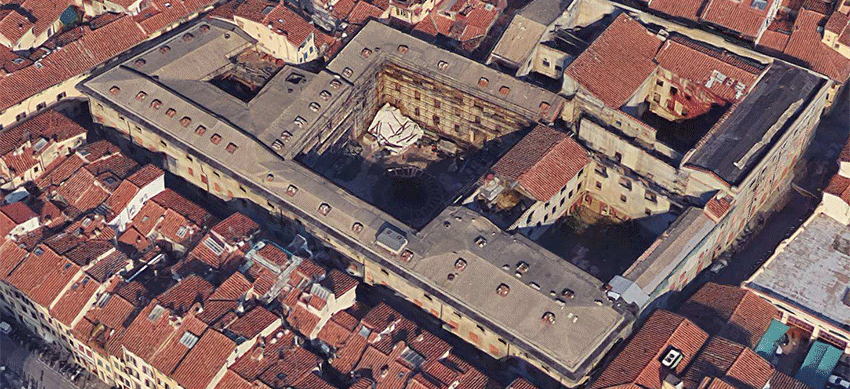
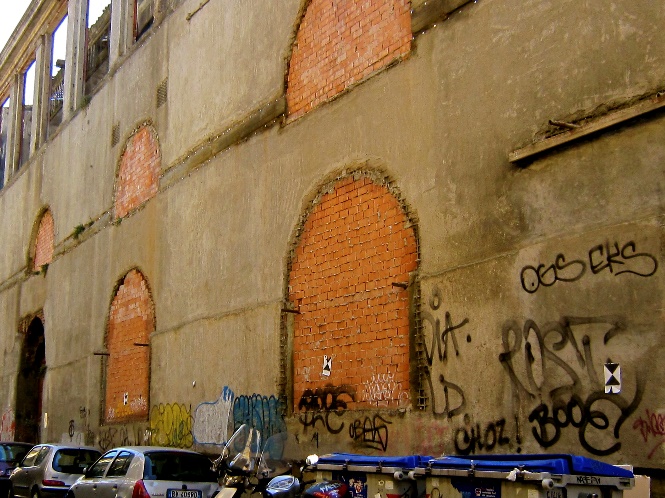
Sant’ Orsola is an enormous former Benedictine convent in the center of Florence that at its peak had more than 300 occupants. An abandoned shell for the last 60 years, it dominates the San Lorenzo neighborhood of Florence. It is comprised of a series of buildings which surround four different cloisters, as you can see above. It is within this shell that my students here have the opportunity to design. They are given the floor plans of this massive complex in AutoCAD (a drafting software) and whatever project they are working on they must design it to fit into some part of the space. This is part of what makes being a student here an experience they will remember all their lives. Because, yes, being in Florence and taking classes here for a semester or two is fabulous and memorable, but actually getting to understand – at a micro-scale – the nature of a building begun in 1309 affects how one thinks about space for the rest of one’s career. Their designs must take into account the building’s existing interior 18” thick partitions; its wooden beams that measure 12” wide by 26” deep; its floors made of either massive stones or, on the upper floors, terra cotta that is hundreds of years old; its groin vaults; and its 30” thick exterior walls with arched windows that are simply enormous. And they have to work entirely in metric, which takes a few weeks to get used to. Above, left and right, are typical views of the bewitching interior of this building, currently inaccessible.
Normally my students back at The New York School of Interior Design are working within New York City buildings where the interior partitions are 5-1/2” thick, where the wood beams, if there are any, are 3 x 12s, where the ceilings are low and flat, the floors poured concrete, and the windows always rectangular. We don’t even teach students back home how to draw groin vaults. And, as any one of them will tell you, those of my students here who have to do so face an extremely complex undertaking. Especially in three-dimensions.
The point is, working at this granular level in a building unlike any the students have ever encountered inspires creativity. But such a building also makes demands. Working in this ancient skeleton of a building the obligations of preservation are always at hand coloring every decision, provoking unexpected solutions.
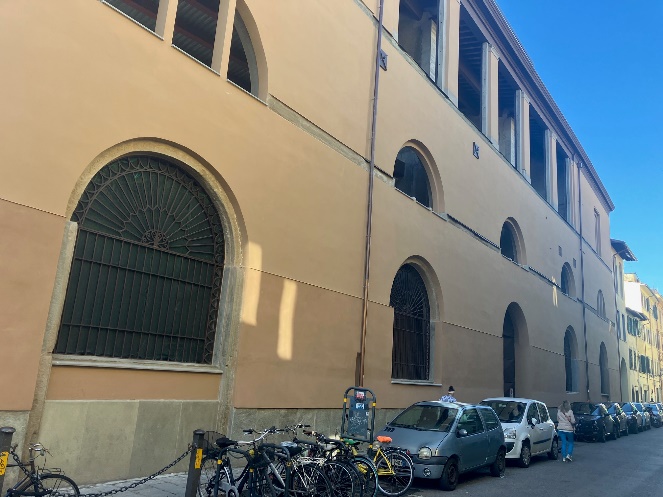
The images below are of the exterior of Sant’ Orsola, on the left from last November and on the right, yesterday. The building is finally being restored and in a few years, once stabilized, will be a great example of adaptive reuse with a wide variety of tenants. It is being done under the aegis of a private French firm[3]
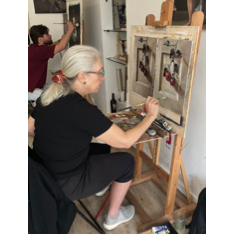
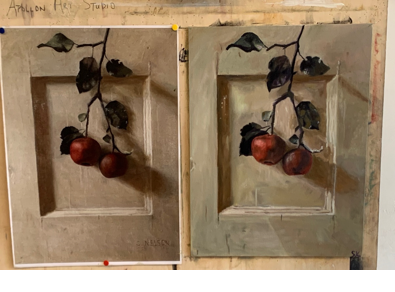
On Friday this week, Susan completed her painting and drawing class at the Apollon Studio here in Florence, the center for the teaching of classical techniques. In the course of five short days she did chromatic color studies, pencil drawings of forms such as spheres, cones, cubes and the ever-challenging egg shape. With oil paints in hand and an excellent teacher at her shoulder, she set about copying a painting – a classic teaching tool. It took her four days and I think the resulting work, on the right, is just astonishing. I am molto orgoglioso of her. Orgoglioso. A delicious, euphonious word. It means proud. Think agog. Which is what I am.
During our time here it has become clear how seriously the Florentines approach the act of making art. There are many, many schools of painting here, schools of sculpture, schools of etching and water coloring and drawing and the general through line is that foundational techniques are still considered of paramount importance. This is sooo unlike American art schools of my experience where you “paint what you feel” and heaven forfend anybody should actually have to learn under-painting, glazing, shading, or anatomy. Here they have not forgotten the centuries-old lesson that craft matters. And starting with a foundation of basic technique is a great way to be free to “paint what you feel”. Susan’s feelings are displayed on the right. I think her taking this up is a perfect example of wanting to learn something new and reaching for it.
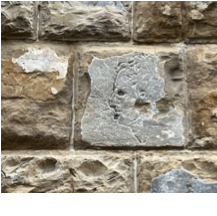
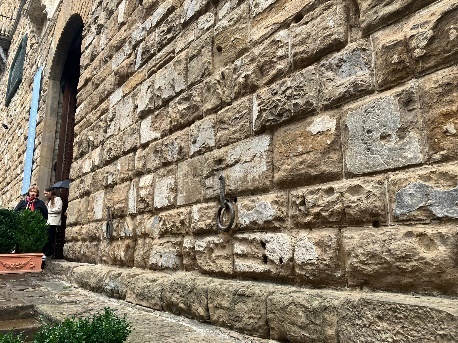
Now this below is something to look for next time you are here. There have been a few articles about a recent discovery that basically proves a local legend to be true. On the outside of the Palazzo Vecchio there is a face that very few people ever notice even though it is right at eye level. The face is sketched into the smooth stone, done by someone very gifted with a stone chisel. Here it is:
Since the 1500s, locals have thought this to be a Michaelangelo carving, done about the same time his David was originally installed just a few yards away. But there were no eyewitness accounts of his carving it.
For context, here you see it near the front door of the Palazzo. Just two years ago a researcher in Paris found a Michelangelo drawing on paper of this very face. For those who have noticed it over the years, it is one small mystery resolved.
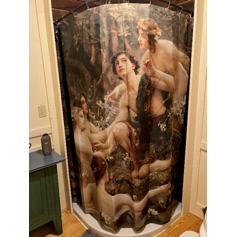
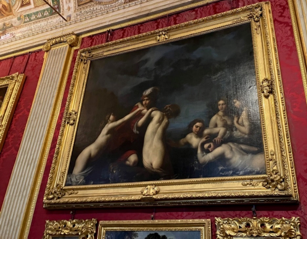
Last week’s Lettera Tredici spoke of visiting old places and seeing new things as happened when we went to the Palatine Gallery in the Pitti Palace for our second time. There I found a Hylas and the Water Nymphs high up on a wall. I am only recently acquainted with Hylas because of a shower curtain I bought on the internet on which he is featured. This past June I completed all the work on the bathroom in our Stone Ridge barn. I have spent the last year converting it into a studio and guest house. It was clear that the finishing touch called for was a shower curtain with verve. And voila! I felt that water nymphs gracing a bathroom seemed very suitable but really, I had no idea who this Hylas was.
My curiosity was piqued by the sight of this other Hylas at the Palatine. So I did a bit of research and discovered that most interpreters of Greek myths acknowledge the “beautiful, curly, blond-haired Hylas” was one of Hercules’ lovers aboard the Argonaut. At a moment when Hercules was not paying attention, the water nymphs, who had been admiring this young man from beneath the waves, swarmed over the gunwales, reached out for Hylas, and made him their own. Hercules searched so long for his lost lover that the Argonaut sailed off without Hercules, in pursuit of the Golden Fleece which I really can’t remember what that was and why they were so hot for it. Herc never saw Hylas again, so goes the legend.[4]
The lesson this week is reach for what you really want. You might get it – and it might taste really good.
[1] My opinion, which you have not asked for, is that while this particular Cenaculo is good, it is no better than some here in Florence.
[2] By 1350, that population was approximately 55,000 due to the ravages of the first great plagues.
[3] Which is ironic in that it was the French – who, under Napoleon, ruled Florence at the time – that closed almost all the monasteries in Tuscany between 1808 and 1810 in what is known as the suppression. It became a tabaco factory after that.
[4] According to Plutarch and Aristotle, apparently. Also, the poet Theocritus (about 300 BC) wrote about the love between Hercules and Hylas: “We are not the first mortals to see beauty in what is beautiful. No, even Amphitryon’s bronze-hearted son, who defeated the savage Nemean lion, loved a boy—charming Hylas, whose hair hung down in curls”.