There is a secret garden here.
The first time I discovered this secret garden, as happens with the character Mary Lennox in Frances Hodgson Burnett’s book of the same name, I found the gate to the garden alluring – and locked.
Then, I went a second time and found the gate unlocked but the ogre guarding it would not admit me.
Eventually, like Mary, I found the key, and the garden is glorious.
Secret. No, it is not really secret. But not many people seem to know about it. I first realized it was there when I looked up from the Della Grazia Bridge and saw a magnificent esplanade of stairs marching up the steep hillside that comprises much of the topography of the Oltrarno. On one side of the stairs were orchards and on the other, a forest. I assumed this was someone’s private garden. Well, the fact is, for quite some time it was. Just two years after Hodgson published The Secret Garden in 1911, the Florentine art dealer Stefano Bardini purchased an enormous run-down villa and garden, close to the famous Boboli Gardens. I have written here previously of these Boboli Gardens, which I quite dislike. They are relentlessly formal and have not an ounce of romance or delight.[1] But not so the garden next door, known as the Bardini Gardens.
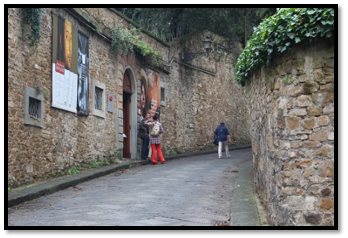
On that first visit, I climbed a very steep, winding, tucked-away street called the Costa San Giorgio. There I found a narrow gate in the middle of an enormous stone wall. I remember it was a Monday. And at the locked entrance to the Giardino Bardini there was a sign that said “Aperto tutti i giorni”. Just as my guidebook had stated. But then, at the bottom of the sign, in very small letters, was a message that translates as: “Closed first and last Monday of the month”. The next time I went, arriving at the gate winded and sweating, the loutish I’m-keeping-this-job-for-life guard at the door would not sell me a ticket as the garden would close at four o’clock. There was no admittance after 3:00 pm. I looked at my watch. It was 3:01. My Italian is terrible. Which was a good thing in this case as I might have said some things that would not have improved his impression of Americans. After that, I went on a Tuesday morning, gained entry, and found an entrancing treasure with all the aspects of an Italian villa garden that one might hope for. The formal stair, the orchard, the loggias, the winding paths through the woods, the belvedere, the stream, the wisteria covered pergola, statues half hidden in the greenery, and a wonderful smell of boxwood, bay laurel and damp earth.
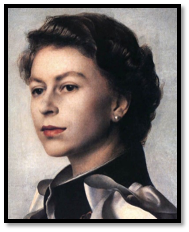
I have been back to this garden with my beloved twice and we find it an amazing oasis in this otherwise treeless city. One that happens to have a sublime view of the city of Florence. But it has something else, something also hidden in plain sight. Within the garden walls sits a dramatic sixteenth-century villa that, followin his restorations, had been Bardini’s home for the few years until his death in 1922. It has a nice little café. But that is not the surprise. There are nice little cafés everywhere here, even on the third floor of the municipal library. No, the surprise lies up a flight of stairs and down a long hallway. It is there you will find the Museo Annigoni. A startling permanent collection of the paintings and exquisite drawings of a twentieth-century Florentine, Pietro Annigoni. We had never heard of him but when I saw this portrait of Queen Elizabeth, it seemed familiar. It turns out that Annigoni (1910-1988) was a much sought after portraitist who was commissioned to paint many heads of state, including John Fitzgerald Kennedy, Lyndon Johnson, Pope Who-ha, and a second, majestic full-length portrait of Queen Elizabeth fifteen years after this one.[2]
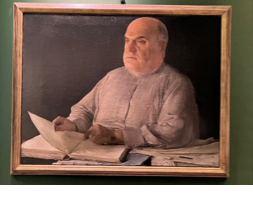
Annigoni was trained in the Italian Renaissance painting traditions that are still very much the curriculum of Florentine art schools today, indeed they are the basis of Susan’s painting class experience last week. Among his work, the most compelling to me was this portrait of his father with whom, the catalog says, he had an exceptionally difficult relationship, and who dismissed his son’s interest in painting as a waste of time. This painting, by the way, is done in tempera. Annigoni and Andrew Wyeth were among the small handful of mid-twentieth century artists who worked in this extremely challenging medium. It happens that the word tempera goes back to Latin temperāre “to moderate, bring to a proper strength or consistency by mixing”. Thus, the same root as in our word “temper”. The laborious process of tempera painting consists of putting down layers of color. Each layer of the painting must dry before proceeding with the next.
Just this weekend I was with our friend Jacques who has taken up tempera painting and was describing the arcane process to me. He is planning to retire soon and is delighted to be engaged in a medium that requires bucketloads of time as he feels that is just what he will be faced with.
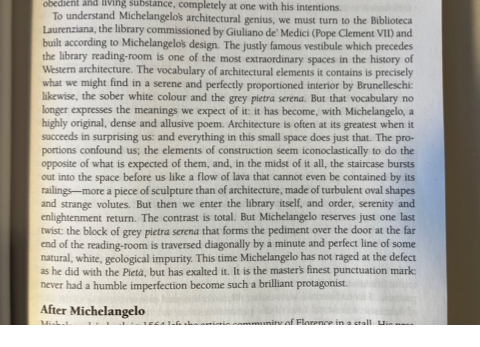
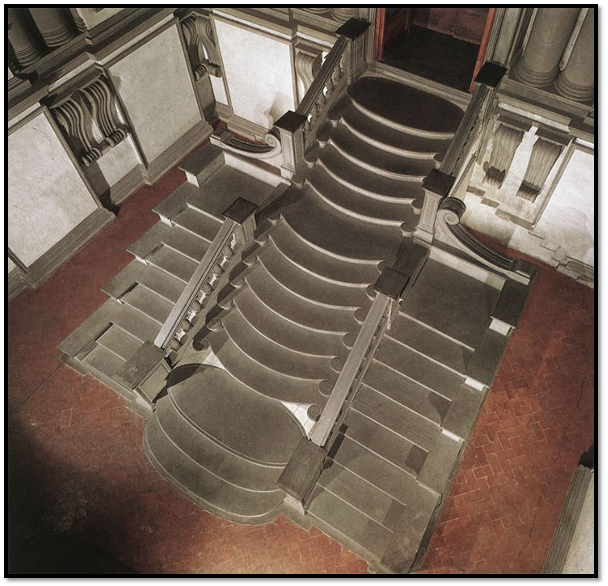
Michelangelo’s Laurentian Library is no secret but it is damn hard to get into. Unless you are a scholar who requires access, there has to be an active exhibit in their small exhibition space in order for them to open it to the public and the last time it hosted an exhibit was before Covid. Well, an exhibition about cocoa just opened and so, with the assistance of my host school SRISA, Professoressa Mohr, our students, Susan and myself were able to gain access this week. If you are not familiar with the library, then there is no more eloquent description of this astonishing series of spaces than what I found in the Blue Guide to Florence, 10th edition, page 31.
These words were written by the brilliant British-born author of The Blue Guide to Florence, Alta Macadam. She is a scholar who lives in Florence and knows the art and architecture intimately. The Blue Guides, if you are not familiar with them, are published for Paris, London, Greece, Crete and other places where art abounds. They list no restaurants, no hotels and no places to shop. They survey only the art and the architecture. The guide includes some of the most obscure places.
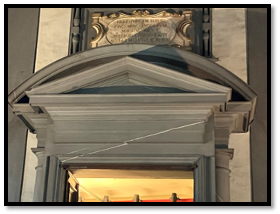
I love her line about the “master’s finest punctuation mark” and couldn’t wait to see it. I was not disappointed. It runs through the great door’s pediment like a lightning bolt as seen in my photo to the left.
Florentines have so much art and share so much of it with so many tourists, you can’t blame them for keeping a few secrets for themselves, or at least making you work for it.
-Warren Ashworth, Florence
[1] This did generate some spirited mail back at me last year from those of you with wonderful memories of the Boboli Gardens from past visits to Florence. Mine appears to be a minority opinion.
[2] Would it interest you to know that this portrait was commissioned by the Worshipful Company of Fishmongers? And that it is displayed in Fishmongers Hall in London to this day and where you may, presumably, visit it if you are a member of that particular guild.