Porchetta.
This shopping-at-the-Mercato thing looks easy, right? You point, they weigh, you pay, they say, “Grazie”. But, in a language one only knows ten words of, it is harder than that. So, I thought I would let you know that today I reached a milestone with my ortolana.
The first two times one goes to the same vendor, they assume you are another tourist, they are perfectly polite, but the purchase brings satisfaction to neither party.
The third time there is a hint of recognition but my Italian is as rudimentary as the first time. It’s no coincidence that “rude” and “rudimentary” are cognates. It is rude to engage in a transaction with no language except uno, due, tre, quattro, cinque which I learned in Mr. Johnson’s seventh-grade social studies class. So, I have been trying to retain words. Words for weights: un etto, due etti; for sizes: grande, piccolo; for less and more and enough – basta – which everybody knows. Words for colors, sizes. Then the words for the products themselves, some of which we all know, like mozzarella. (If you come to Italy be sure not to buy mozzarella. Because, if you do, and then you eat it, you will never again be able to have mozzarella back in the United States where white rubber seems to be one of its ingredients.)
On the fourth return visit the greeting is more cordial. And I begin to know the names of things. Cachi (persimmon) is a nice new word. I got quattro of those today. I always stumble over the word for apple which is mela but comes out as malo which means bad (for this I blame Jacob’s heart-wrenching solo at age eleven. This was in New York City Opera’s production of Benjamin Britten’s The Turn of the Screw where he played the doomed boy, Miles, with Tony Piccolo as chorus master. The song was called Malo. It is all about bad people and apples).
A brief description of my ortolana, my vegetable seller: she is about 5’-1” tall. To reach the pomodori neri from their upper perch she climbs up two boxes. (Here in Florence, probably all of Italy, the customer never touches the produce unless they are specifically invited to and then only with a plastic bag on one’s hand for protection.) She is younger than I by fifteen years, very professional and quite proud of her produce. On my second visit I made the gaffe of buying zucchini, which she also sells, from the vegetable man across from her. I received from her a hard look. She speaks no English which may simply be a choice to keep at bay the English-speaking tourists who swarm the Mercato. She usually wears a dress, warm stockings, and a big apron with lots of pockets.
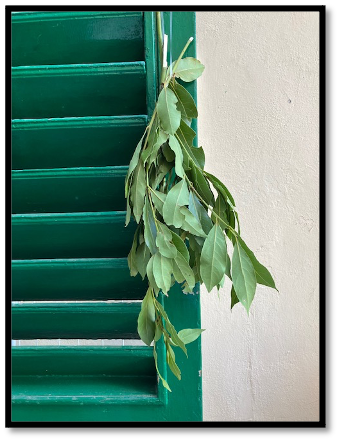
Today’s milestone visit to l’ortolana was my tenth, I think. Not only was I greeted with a lovely smile but I was given a bunch of fresh bay leaves and – a touch on my shoulder, which is a good deal higher than hers. It was a small moment of satisfaction on the part of both parties.
And then there is the porchetta. So, I lived on this earth for 66 years before I ever tasted porchetta. That is a very long time. There were 66 years between the first flight at Kitty Hawk and the first moon landing, just by way of example. I first had porchetta at Jacob and Peregrine’s wedding. To describe it – I can’t – I am running out of superlatives. You are going to stop believing me because of their overuse. I will just say it was very good. Now, today I went to my other favorite stall at the Mercato to buy our olives, cheese, and Tuscan salami. The woman behind the counter, perhaps because this is my sixth time there, gave me a little taste of everything before she prepared my orders. Just as I was about to say basta, I saw she had a lovely, fat roll of porchetta and I indicated that I needed some slices of that. So, she gave me a taste. As I took it in my mouth, I felt like I was having a religious experience. I nearly wept it was so delicious. I told her it was squisito. Which, as a review, was inadequate. I really wanted to tell her that I had first experienced porchetta at my son’s wedding which was just this past summer and that I had never had it before and that I felt like I had been missing it all my life and that the wedding was just this sublime three-and-a-half day sumptuary of joy and love with music and food and humor and tennis and that her porchetta was making my knees weak. But I didn’t tell her any of that because I don’t know the word for knees in Italian.
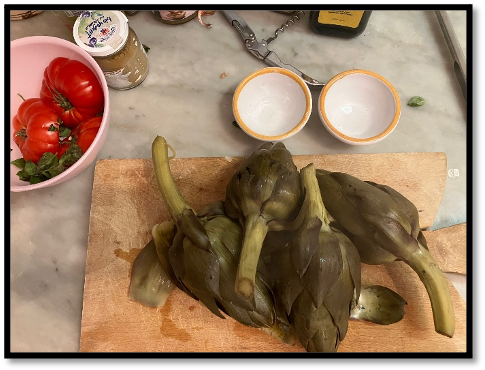
While we are on the subject of food, I just wanted to say that last week’s artichokes were delicious -though they were not delicioso. Susan’s amazing Italian teacher, Marco Pelle, says that one avoids using delicioso when discussing things done in the kitchen. He advises the adjective is reserved for things done in the bedroom. Good to know. Thank you, Marco.
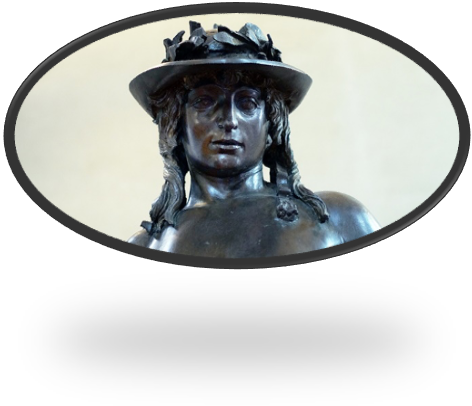
I mentioned bay leaves. I don’t want you to think we have just been eating, neglecting art all week. We did indeed get to see the most exquisite bay leaves in Florence with our friends Deborah and Ian. They are here for their first visit ever. Susan and I have held off going to the Bargello so we could see this divine sculpture museum with fresh eyes, side-by-side with friends. The Ashworth- Kanders were last in Florence with Sam and Jacob in 2007. We visited these famous bay leaves then, but 2007 was a long time ago. Rest assured they are still there. (Yes, they are indeed bay leaves. That’s what laudatory laurels are made of -bay laurel – and it is why Linnaeus named the plant Laurus Nobilis). There they are, on top of his magnificent head, wound around his helmet which I always felt looks much more like a straw hat than a helmet. A straw hat that he put on for a Sunday stroll. A naked Sunday stroll. Naked, save for his hot, hot, calf-tight boots, his sling shot and, of course, his terrible swift sword.
The truth goes marching on.
Warren Ashworth