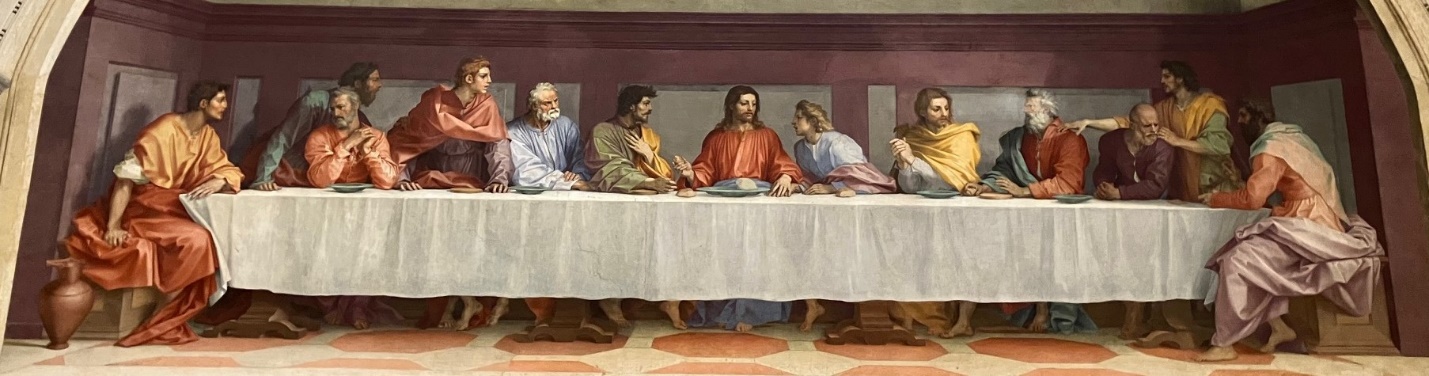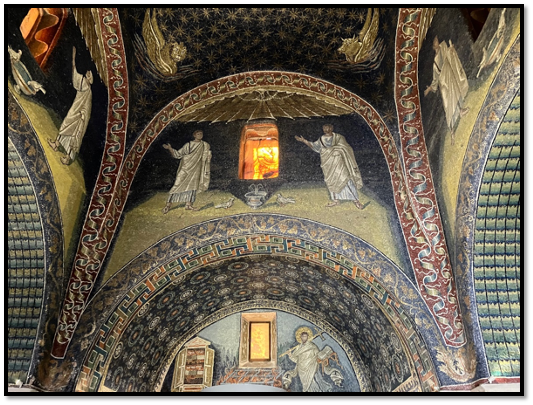
It has been a good week for dining together with friends, particularly friends who are all apostles. Yes, I have been tracking down cenaculi (the plural of cenaculo, which is the space in which the last supper happened and is the colloquial term for last supper paintings). I feel like I have been very fortunate to visit with two exceptional versions of this trope, in two glorious rooms, in obscure parts of this city, unfettered by tourists.
Oh no, I hear you groan. Last Suppers? Really? Wine doors were fun but maybe he has gone over to the dark side?
Really, I haven’t. But listen – here is what happened this week and why I have to send you this letter – we got to witness, in living color, how the Dark Ages began. Yes, I know that some prefer to call it the Medieval period but from the point of view of art, it was the Dark Ages. On Friday last, we went to visit the place that encapsulates the most glorious, the most magnificent record of their beginning! How cool is that?
I will start there, which is the city of Ravenna. But, the Last Suppers loom.
Ravenna. What can I say that hasn’t been said about Ravenna? Probably nothing. It is a city on the Adriatic. If you have been there, fantastic. I had not. A particular friend who is an architect (and many other things) wrote to say, “Stop everything and go!” That was Thursday, September 29th. So, on the 30th we were on the train (24 Euro round-trip). Susan needed a break anyway. Carry My Own Suitcase is going very well and there have been nice bits of good news: dwb (driving while black) is now to be performed live, in 2023, in Des Moines, Iowa; Greensboro, South Carolina; and Birmingham, Alabama. Carry My Own Suitcase tentatively will be workshopped in Washington, DC in addition to its spring workshop in Lawrence, Kansas. And in the summer of 2023 Jade Star Hotel will have a vocal reading. She is working much harder than I am. I get to go off to obscure monasteries. She gets to go out for gelato. She was glad to get away.
From 420 to about 650, CE, Ravenna was the axis mundi of the Western World. It was the capital of many overlapping, competing political entities including, but not limited to, the Goths, the Ostrogoths, the Visigoths, the Western Roman Empire, and the Byzantine Empire. Some names you might remember are Chief of the Ostrogoths Theodoric; Emperor Justinian and his powerhouse Empress, Theodora (no relation to Theodoric). Perhaps the Goth Queen Siouxsie and her attendants, the Banshees, rings a bell?
Mosaics. Ravenna has the most magnificent mosaics in the world. There, I said it. Go ahead and argue with me. Yes, the ones in St. Marks in Venice are stupendous, those in Rome and Pompeii amazing, but none match the level of artistry seen in the Basilica of San Vitale, circa 532-557, or the Mausoleum of Galla Placidia, circa 425-450. The figures in these mosaics – even the animals – have individuality, vibrancy, pathos, and movement.
But really, you have to go there to believe it so I am not going to offer a lot of photographs. I myself was not going to go until I was told I must. I had learned about them in my classes but thought well, I’ve been to St. Marks, how can you top those. Wrong. So, now I’m telling you. Go.
But what was he saying about the beginning of the Dark Ages, you ask?
Yes, that’s what I said. I said it because just a few blocks away from the Galla Placidia Mausoleum there is a church built just a 150 years later. It is full of mosaics, just crammed with them. And guess what? The artistry is all gone, forgotten. The figures there are wooden, lifeless, with no personality, individuality or emotional resonance. The mosaic masters, trained in the workshops of Rome, who then had to flee Rome after its sacking, the ones who worked in San Vitali and in the Galla Placidia Mausoleum, are – by 650 – dead and gone, along with Western art for the next 750 years.
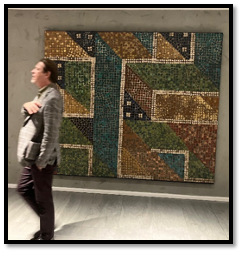
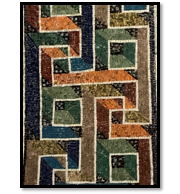
At right is just one detail from the mausoleum of which we took dozens of pictures. It turns out Susan and I are not the only ones who admired this detail. The other night I went to Florence’s opera house (Susan was down with a cold) to see Il Trovatore and at the top of the stairs in I found, to my astonishment, this painting (at left). The wall label says it is a fragment of an opera stage set designed by Florence’s home-town boy, Franco Zeffirelli, for Absolutely, a Pirandello opera. An absolutely direct grab from a pattern designed 1,570 years ago. As opera fans know, Zeffirelli, who died in 2019, was responsible for dozens of the classic sets for the Metropolitan Opera. He has quite a presence here with a whole museum dedicated to his work.
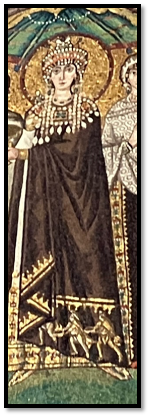
Speaking of influences, to the right is Empress Theodora from San Vitale. It might interest you to know that my beloved Gustav Klimt visited Ravenna twice, in 1903 and 1906, before painting Portrait of Adele Bloch Bauer I, now known as The Woman in Gold. He wrote back home to friends that he was absolutely transported by the extraordinary mosaics at San Vitale and it shows spectacularly in his work.
Now, the Last Suppers are coming soon. But not quite yet.
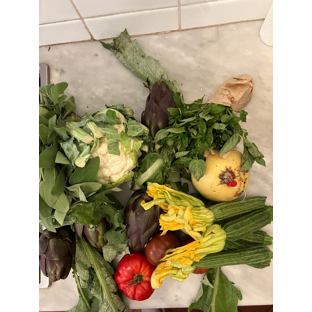
Not-the-last-supper tonight at Via Ricasole, 33, is going to include something I am very excited about because they have just come into season here at the Mercato Centrale – Artichokes. Lovely purple artichokes on big, long stems with their spiney, thistley leaves. L’ortone, my vegetable seller, has three kinds of carcofi and just choosing between them was an exercise in knowing nothing about nothing. It may be silly, but in cookbooks from foreign lands I have seen photographs of these lovely exotic stalks but never had a chance to buy and cook them. I have just written an Italian associate here at the school to get advice on how to prepare them and she has replied with instructions. I am ready. We are also going to have Multicolored Tomato Tartlets from the New York Times. Look them up. They look great. And yes, we have New York friends coming for supper. But no apostles. Very fun.
But no dessert baking. I am not set up for baking. My local bakery, Il Vecchio Forno has everything one needs. And it is old. About 200 years old. But that’s nothing. Our pharmacy was founded in 1427! How wild is that? They could have sold toothpaste to Donatello! Maybe they sold gum Arabic to Botticelli’s wife.
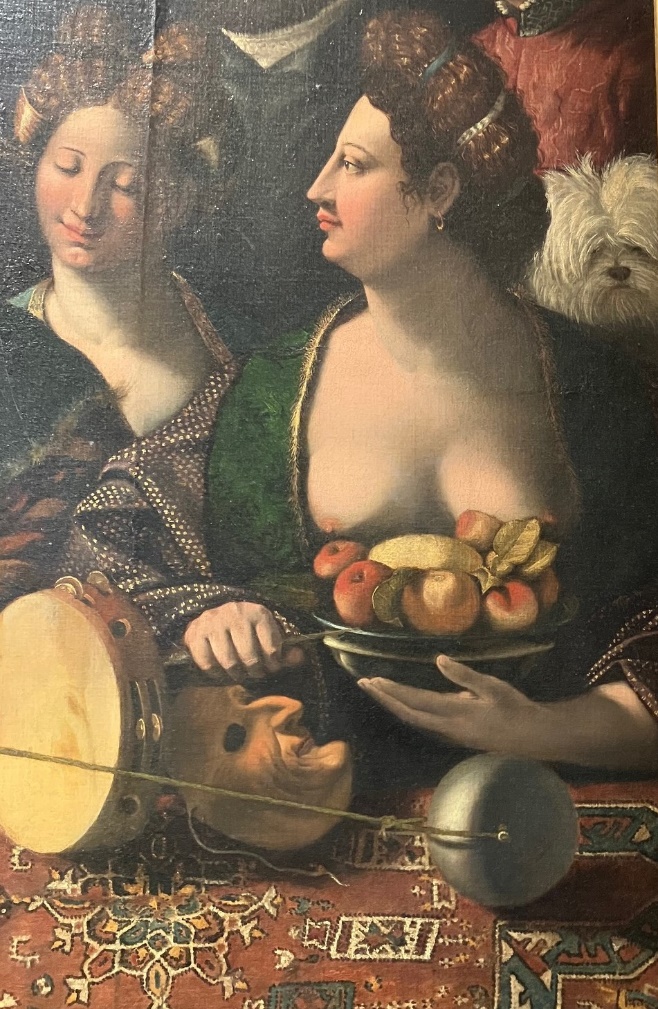
Oh, one more cornucopia for you that I can’t resist bringing to your attention. This is from the Uffizi. It just seemed to say so much about why I like cooking. The artist is Dosso Dossi. I am not making that up.
Maybe I will just leave you with this about the two L’Ultima Cena that I visited because really, you need to be in the rooms where they were frescoed to understand why I care about Jesus and his crew all of a sudden.
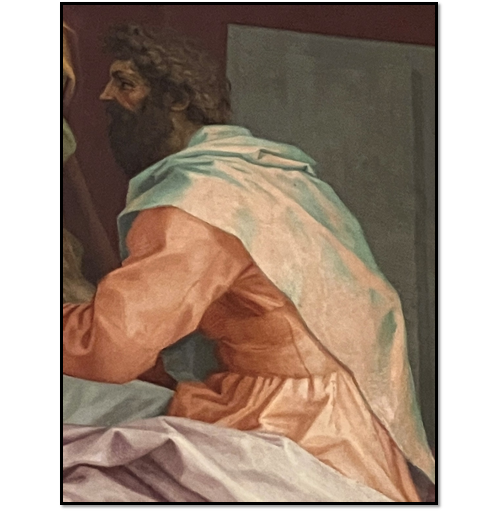
So, instead, look at this detail on the next page from Andrea del Sarto’s version at San Salvi Monastery (1505). This is a small part of a huge fresco. Almost all these cenaculi, including Leonardo’s, were done as frescoes. Fresco: from the Italian adjective for “fresh”. The key to this very-nearly-lost art is that one is working on fresh, wet plaster, mixing dry pigments with water, applying them to the wet plaster and working very fast in order to achieve absorption of the pigment before the plaster dries. So just look at this apostle’s gorgeous garments and ‘splain me how the heck he did that.
In spite of their grim subject, these Last Suppers are really about a party; a big, broad, bountiful celebration; a banging kegger; Florence announcing to the world that the Dark Ages are over.
Ttfn,
W