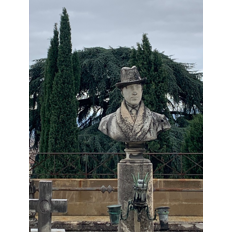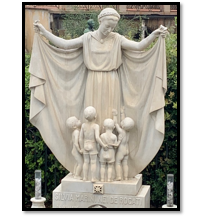
Being dapper after death is a rare thing. But here in a beautiful, terraced cemetery high above Firenze one man continues to impress, though he left this world in the 1930s. He is to be found next to San Miniato al Monte, the eleventh- century church and monastery overlooking the city, the most visible and vibrant of the few remaining working monasteries here. We arrived inside in time for the tail end of a Sunday mass. Susan spoke with one of the monks afterwards, an extremely handsome young man, and found out that vespers are sung here every evening at 6:30 in the Gregorian style. We look forward to returning. Though it is a steep climb, as you traverse the hill there is a sequence of huge man-made grottos and waterfalls that accompany you. All the rage in Europe in the late 1700s and in the 1800s, these stone grottos have been carefully restored. And then there is the view, oh my, the view. Another remarkable tomb is this for a mother of four who died in the 1940s. The sculptor of her monument had remarkable skill. This, from one slab of marble, is poignant and quite beautiful. There are other graves worth spending time with. It is clear that great sculptors were kept employed here at least until the end of the second world war.
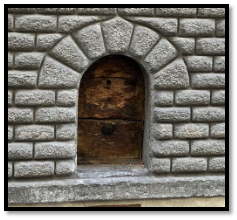
On our way walking back home we chanced upon this wood door in an stone wall that I knew you would like. I have now found two more that are similar. This is a working door, the servant’s entrance, it would appear. Or maybe it is the mother-in-law door. Just pretend you don’t see it.
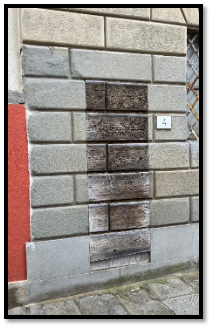
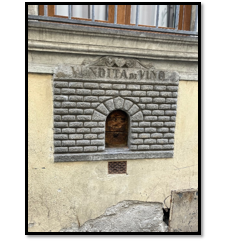
Speaking of doors, there are so many delights to be seen just walking in this city. I offer this example that I photographed Monday. What is it, I wondered to myself. I just had no idea. The words are clearly carved into the miniature real-stone wall but why was it here, four feet off the sidewalk on the façade of a very old palazzo? Vendita di vino would simply mean “sale of wine”. But what’s with the tiny door? Well, I get home that day from my perambulations in time for a lovely Zoom chat with our friends Deborah and Ian, who have been doing their research on Florence as they are coming here in October. Did I know about the wine doors, they asked. “What?”, says I, “Wine doors?” It seems they had been listening to a podcast about an obscure aspect of life in Florence and had learned that in the fifteenth through the eighteenth century, it was decreed that noble Florentine vineyard owners would not be taxed on the sale of their wine if they sold it directly from their homes. So noblemen’s palazzos all over town were fitted out with wine doors where the transactions happened anonymously. These apertures are just big enough to pass a fiasco of wine through – as the straw covered bottles of Chianti are known. So, not paying taxes was dear to the rich even then. The amazing thing to me is that this conversation happened one hour after I took the above photos. Amazing. And there is no mention of these in the guide books. There are not that many left but now that I understand what they are I have seen two others. There is a gelateria in center city which will sell you a café or a gelato through theirs and, apparently, sold many that way during the pandemic. These wine doors were, by the way, very popular during the plague of 1667 which hit Florence particularly hard.
Now then, a little art history. Perhaps you need to get yourself a glass of wine before you settle in for this. Seems like a good idea, right?
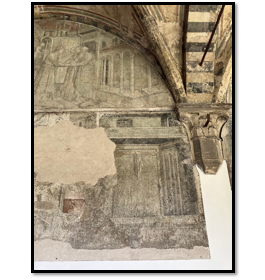
I went this week for a visit to a church called Santa Maria Novella. As an author of a not-overly-long work of fiction I think it is wonderful that the Florentines have a church dedicated to short novels. This church is just one great big celebration of the Rinascimento, which is the Italian word for the Renaissance. What I don’t get is, if the Italians invented it, how come the French word is what we use? What were the French doing in 1419 and 1430 and 1450 and on and on? Not much, franchement. Inside Santa Maria Novella is Masaccio’s The Trinity which was no doubt mentioned by my college art-history teacher but I was asleep because the class was at 8 o’clock am. Il Trinita represents the first time perspective was used architecturally to place us at eye level with the vanishing point (correction: the first time since Roman times, after which we forgot everything and if you want to know why, read The Swerve by Stephen Greenblatt which explains it all). This was also Masaccio’s – I spoke of his Brancacci Chapel in a past letter – last major commission because he died the year this was finished at age 27. There are some startling other frescos all over the immense church. Then there is a cloister full of them which were badly damaged by eight feet of water the 1966 flood. The cloister frescos were all by Paulo Uccello, made 600 years ago in a very rare monochromatic style. Only one wall of them remains which, ironically, portrays Noah’s Flood. I show just one image from the series here – a towel hanging on a towel rack, which I found delightfully quotidian.
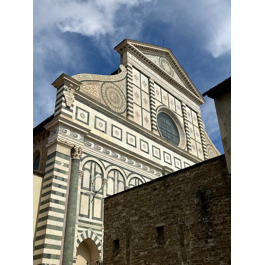
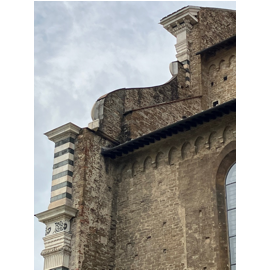
I called this building a celebration of the Rinascimento not only because of what is inside. Observe the upper portion of the facade. That was added in the 1440s by Leon Batista Alberti whom I mentioned last week. Note how gracefully this marries with the lower portions dating from centuries before. And I can’t resist showing it from the back. I think it is quite beautiful even from there. You are seeing here the most important façade of the time – an elegant, intentional composition; a fugue on the square, the circle and the golden mean, magnificently grafted onto an old tune.
Hey, by the way, I got some answers back from my letter last week and I thank those who contributed notes. Most particular was the note that becoming Bill Ashworth is not such a bad thing to be. And that is quite so. Another was to say that the loggias in Bologna are indeed there by municipal decree. Thank you, Richard. And I got a number of notes about being held down and forced to eat bologna sandwiches on white Wonder bread.
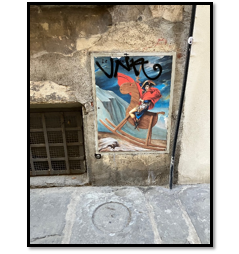
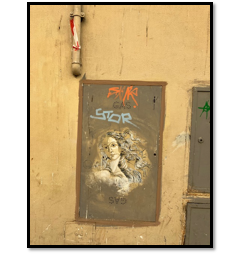
Art history is escapable some places. But it is not escapable here. These are just two examples from gas meter covers. The one on the right is painted on canvas, by hand, and then pasted onto the metal panel. The one on the left, on our street, is a five-color stencil. If Botticelli were bopping down the Via Ricasole today and saw this, I think he would be a happy man.
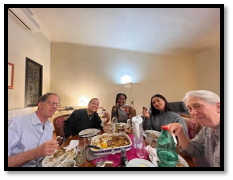
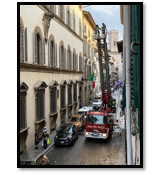
Speaking of our street, I looked out our window and saw this on Monday. It was not a fire they were there for but a large piece of a stone cornice that had crashed to the pavement and broke into smithereens (a word I don’t get to use much). No one was hurt, thank goodness. They closed the street off and spent the next 24 hours stabilizing the cornice, cleaning up the debris, inspecting all the other cornices with bucket trucks and being incredibly efficient about addressing this, which must happen here with some regularity. I was quite impressed. (And yes, that is the bell tower of the Duomo behind the fire truck). The street closure did make it tough for my students who were all coming to dinner that night. The firemen let me escort them to our door from the corner. Here is a wide angled dinner photo with some of the kids.
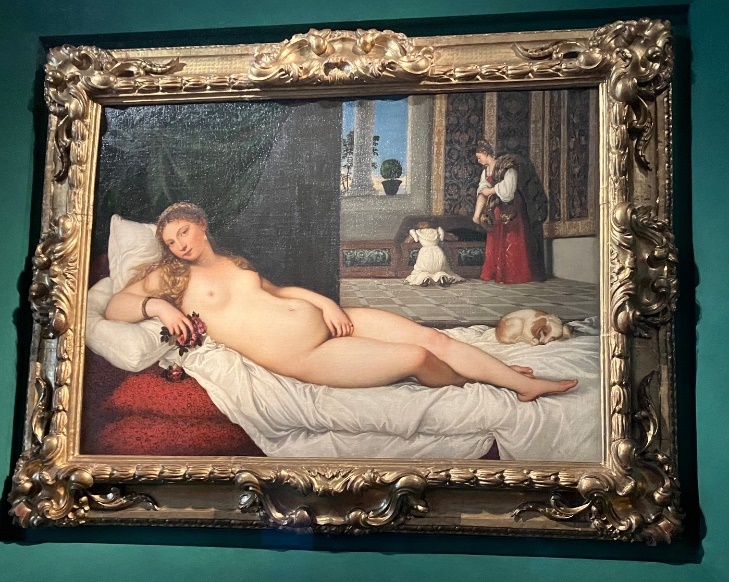
Before I get to wishing some of you a Happy New Year, I think I will drop in a little pornography I found in the Uffizi courtesy of Mr. Titian (His name in Italy is Tiziano Vecellio). Yes, I went back on Tuesday. I was there at 8:15 am and I was the second person in the museum! So I got to have much of it to myself. What a contrast from two weeks ago! Among the many treasures, I found a Fra Filippo Lippi Madonna that was just sublime.
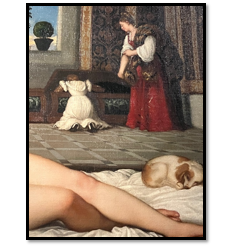
Finally, there I was in the third-to-last gallery, alone, with the Venus of Urbino, as she is known. A lot of commas in that sentence. But you yourself might hesitate if you found yourself where I was, unchaperoned. As any Florentine would scurry to point out – Titian was a Venetian. Florentines don’t really go in for this voluptuousness. And that is quite true, they don’t. A kind of reserve is very evident here. But there she was and there I was and really, I had only one question for her: “What is that woman doing with her head in your trunk?” The eternal surprise about the painting of this babe is the first thing you look at, the first thing, is not the naked woman on the divan, but the mousy woman in white at center of the canvas with her head in a trunk. Go ahead, pull up a photo of this at a larger scale and tell me your eye doesn’t go straight to her backside.
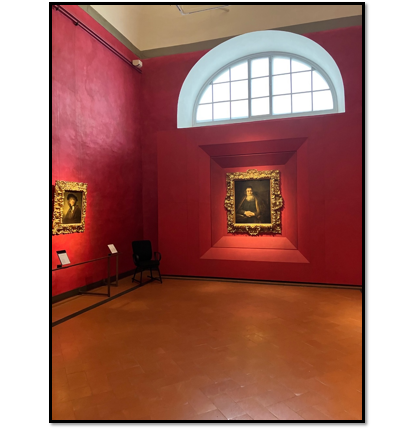
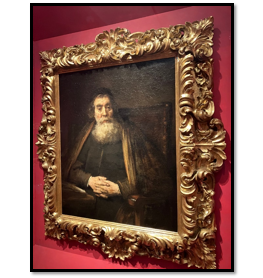
The Uffizi is arranged in chronological order, starting in the late 1200s and going until the Florentines stopped making art of any consequence, in the mid-1600s or so. In fact, if you read The Stones of Florence, Mary McCarthy’s fifty-year old, spot-on book, she points out that basically everything here stopped in 1540. The Medicis ended, the Rinascimento ended, and the light just dimmed. Thus, the Uffizi graciously ends their whole two-floor itinerary with a room full of Northern painters, Mr. Rembrandt van Rijn in particular. And as you enter this last, stunning room finished with a new coat of carmine Venetian-plaster walls (I am sure the Florentines do not call it Venetian plaster) you are bid farewell by this striking, late Rembrandt portrait of an unidentified rabbi.
Happy 5783.
And yes, the light this time of year is very special…