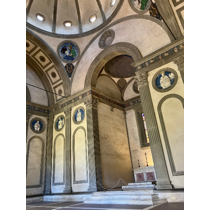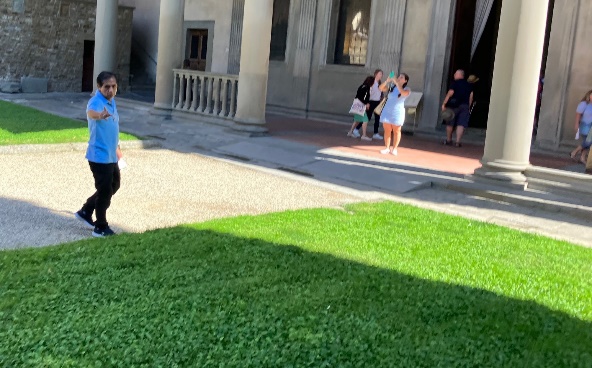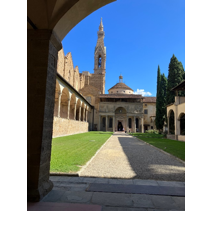
My first brush with authority here in the Republic of Florence. “Non camminare sull’erba” or something similar – “Don’t walk on the grass!” It is one of those things I won’t ever get used to. I was on the grass to take a picture of a wonderful statue of a robed man with his hand up in the air which, to me, was a simulacrum of the Master’s hand (Sorry, it’s the only word). The building just behind the grumpy man is one of the Master’s capolavori, one of his masterworks. He being Brunelleschi and the work being the Pazzi Chapel. His smallest public project and his purest. It is a cantus firmus that sings of just two shapes: the spere and the cube. Jacob Ashworth taught me what a cantus firmus was when he was about 14. I have always liked learning from my children.
This song in pietra serena stone and white plaster is one I have studied in many, many art and architecture history classes but have never seen. To stand in it, alone for a few minutes, was like a gift box sent to me years ago which I was only just opening.
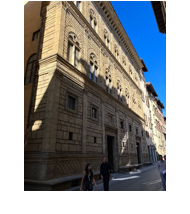
Here is another building I have often studied and this one, I am embarrassed to say, I have now walked past three times without realizing it. It is called the Palazzo Rucellai. It is Renaissance architect Leon Batista Alberti’s most well-known house. But it just fits into (or rather, helped establish,) the Florentine streetscape. There is no marker outside Via del Vigna Nuova, 18, sayingthat this singular 1446 house is in every architural history book in the Western Hemisphere. No marker saying the facade of this house launched a thousand others. Nothing. Just the house number, 18. Inside the ground floor is the retail store Endo. I have no idea what they sell.
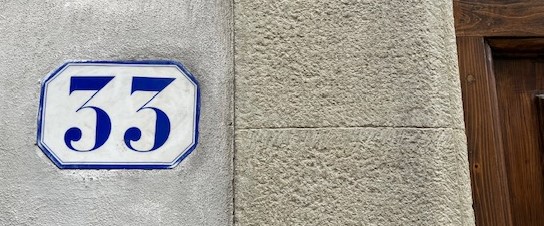
Speaking of house numbers, I am amused at the number on the front of the apartment building in which we live. We have lived at 133 West 82nd Street for years. My first job was at 33 Greene Street. My first investment property was at 233 South First Street and now, here we are at Via Ricasole, 33. Numerology enthusiasts aware of negative portents appertaining hereto should not reply to this.
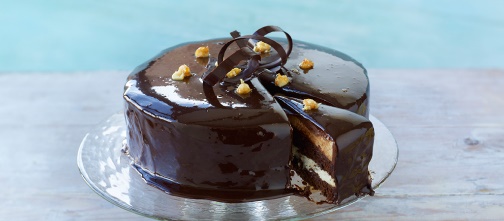
Close watchers of The Great British Baking Show may want to. They may have heard of a dessert I only encountered for the first time the other night. It was by far the best dolci I have had since we have been here. It is called setteveli (seven veils). What an evocative name for a dessert. Prue Leith’s recipe for it is the first thing that comes up on the blessed internet. She says it takes an hour and a half to make, “hands on time”. If you do it in less than four hours, please write back because you’ve won!
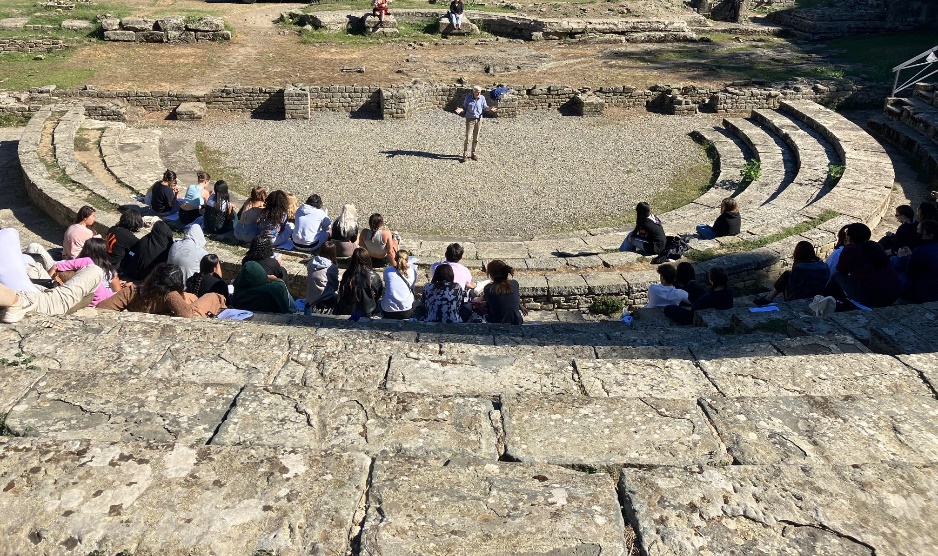
Susan has been working extremely hard on Carry My Own Suitcase. She has been deep in the zone for two weeks now and is making great progress. But, when she realized two days ago that she needed to go back to the entire first act and, out of love for her musicians, change all the 16th notes to 8th notes and everything from 2/4 to something called “cut time” (Numerology enthusiasts aware of negative portents appertaining hereto should not reply to this) she said, “I need a break!” And so, yesterday, we jumped on the #7 bus and in twenty minutes were in the lovely hilltop town of Fiesole. Nestled in the lee of this cozy, vibrant village are a Roman theater, an Etruscan 6th century BCE temple (I am not clear on who they were worshiping there), and some Roman baths. In one of those fortuities that happen when one travels, when one is – perhaps – more open to accidental encounters, we found ourselves in the middle of a lecture by a NYU professor whose name, we later learned, was Eric Nicholson. Well, I thought, this will be a fine test of the putative-amazing-acoustics of Roman theaters, and indeed the sound of his voice travelled to our ears quite clearly. But that became almost beside the point. As we sat there, we found ourselves immersed in a superb lecture that went on for another hour. It was all about Greek theater, the great Greek plays, the transition to Roman theater, and about how both Greeks and Romans felt that great Theater could save the city, any city. He spoke of the development of in-ground stone theaters such as the one we were sitting in, why they were built, when, how and for whom. We were both riveted. This just does not happen walking around the Upper West Side.
It was not just a fascinating lecture but a demonstration for me on how to teach. The last lesson I had in teaching was the masterful one Rob Horner gave me eight years ago right before I started at the New York School of Interior Design. Now, here was this Professor Nicholson (at least five years my senior) addressing his subject, charging all over the gravel stage, hand gestures as lively as his voice, entrancing his audience. After forty-five minutes, when some students began fidgeting about in their stone seats, he went off-stage (to the stone barrel-vaulted wings) and reappeared in a Greek mask and gave a speech from Aristophanes’ The Frogs, part of it down on his knees in the gravel, beseeching the audience for help. This was followed by another speech in another mask. Then, donning a woman’s mask and voice, he performed from Plautus’ the _______. Swinging his hips on his way off stage, he returns without a mask, without a script, and recites (performs) the seven stages of man scene from As You Like It. All this to elucidate us about the power of the mask. Never have I seen a teacher hold students so in the palm of his hand. We introduced ourselves and thanked him profusely, and hope to meet him in a cafe some time next month for conversation.
We went to La Fiesolano for lunch and had the best porcetta I have had since Jacob and Peregrine’s wedding which was the first place I had ever had porcetta, not having known it existed before – more things learned from my both my children, who introduced me to it.
Last week’s letter had a riddle in it about a certain painting on the cieling of a room in the Ufizzi. Alas, we are no closer to knowing about why it is there. The education director of the Ufizzi was asked but had no idea about it. Humph. But I hope you will look for it when you are here.
Bologna. Did you grow up eating it too? Really, the reason anyone under forty reading this letter never had it is because your parents were force-fed bologna all their young lives. We were stuffed with it when I was growing up in California, we had more of it when we moved east. Susan says she was sometimes given bologna sandwiches for days in a row in Kansas City. And really, I have never met a soul nostalgic for bologna. And how did it come to be pronounced “baloney”. And what does it have to do Bologna?
Well, I can’t answer any of those questions but I can tell you the city which was named after America’s best-selling lunch meat was a wonderful surprise. We now know of it because we took the 39 minute non-stop fast-train there this past Sunday, to meet our friend Nancy Haberman. It is always nifty to encounter friends in some crazy, far-off place. The surprise about Bologna is the loggias. Yes, I know it is famous for its loggias and yes, you told me that, but I just figured they were here and there. JFC there are loggia’s everywhere! Builders started incorporating them into their structures in the 13th century and just did not stop. A good portion of the city’s buildings are 19th and 20th century (much bombing during WWII) and even in these, loggias from one building just slide into one next door. One walks for blocks and blocks beneath them. It turns out all you who have been there were not making this up. But if any of you know how this came about – by decree, fiat, or the miraculous cooperation of the confraternity of real estate developers – please let me know.
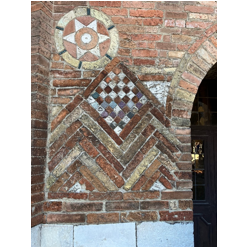
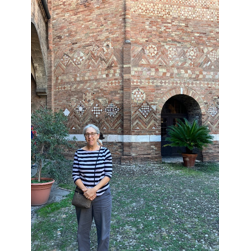
The other big surprise there, for me, was Santo Stefano, a complex of churches and cloisters started in the 900s and continuing through the 1400s, CE. The first thing you may notice in the photograph to the right are the stripes. Yes, I have always liked that shirt. But the stripes I woulds’t call your attention to are behind her on the 11th century octagonal church. The stripes and patterns in the brickwork are assolutamente squisito. It sounds so nice in Italian. Though, of course, they could very well be assolutamente squisite. I have no idea. We are the people who named their female cat Pozzo, not Pozza. Here is an upclose view of the stripes and patterns because I can tell you are squinting. I know, exciting isn’t it? Makes my heart beat faster.
Ok, I’m stopping. This is about where I started falling asleep in my father’s regular Ektachrome-slide shows about his and Lou’s travels to Italy. Oh my god, am I becoming my father?